Starting From Minus: How to Talk to a Girl at the Grocery Store (After Taking Her Cart)
Every scene in this series so far started from neutral or better: a party with a mutual friend, a coffee line, a wine bar, a train seat. This one starts from guilty.
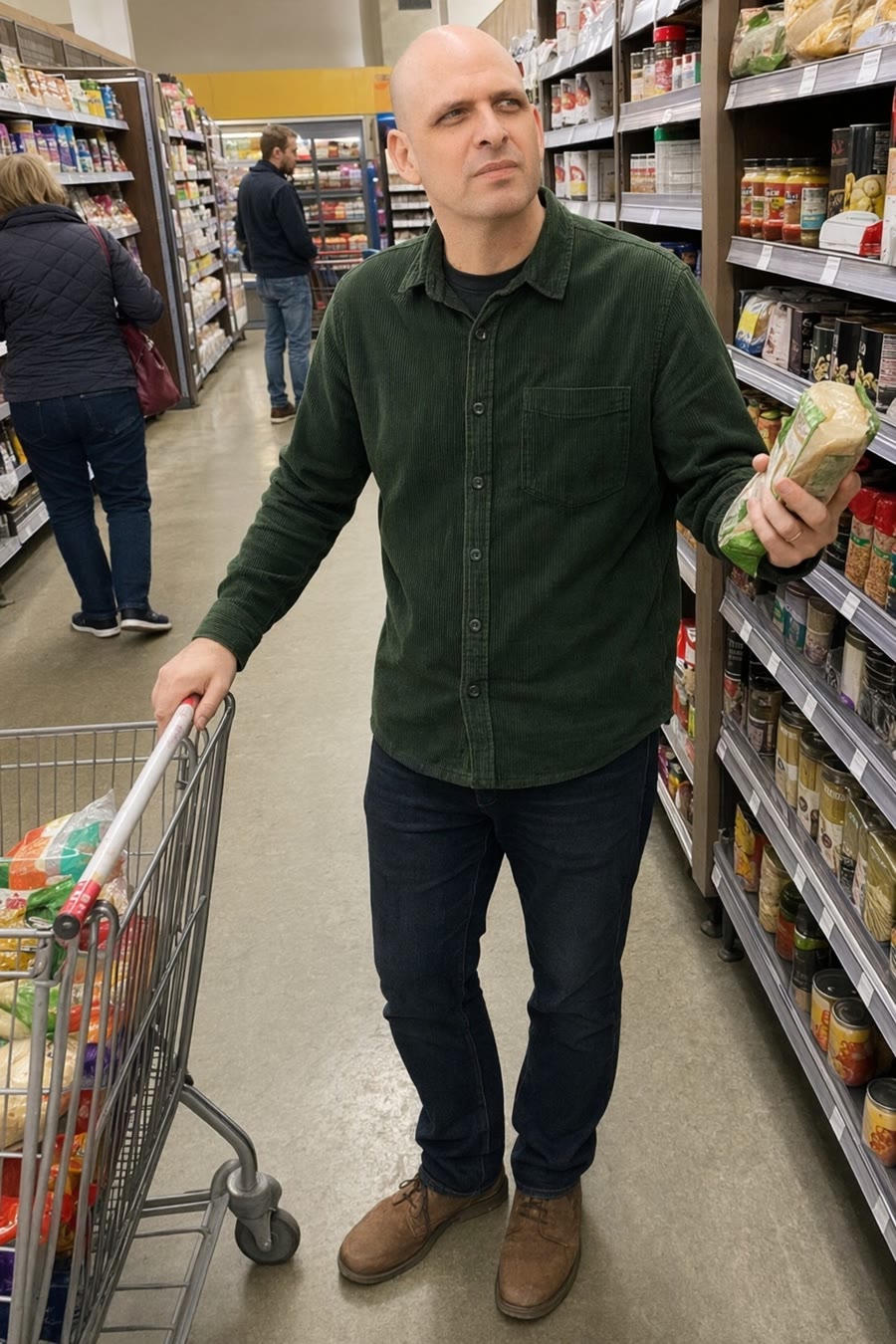
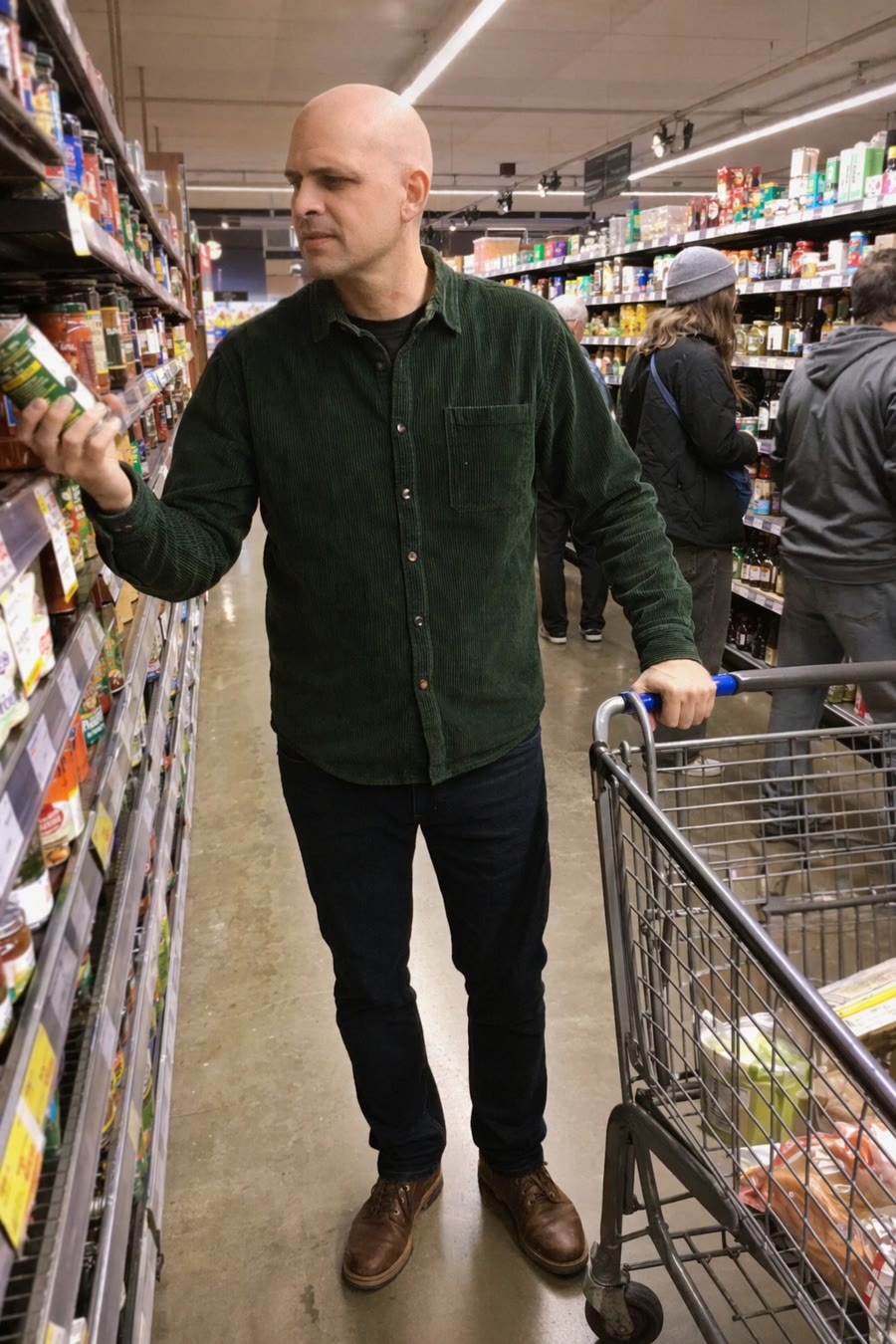
Thursday, 7:40pm, a neighborhood grocery store in the pre-weekend rush. The store radio interrupts itself every two minutes for "cashier to register four." Mike is ten minutes into his shopping, answering a text while walking, and when he looks up in the wine aisle, his cart contains things he never picked: arborio rice, parmesan, mushrooms, white wine, a pack of birthday candles. He took someone else's cart. His own, chicken and frozen okra, is somewhere by the freezers.
And here she comes. Thirty-something, blazer over a t-shirt, an employee badge hanging backwards on a lanyard, end-of-day ponytail, tired eyes. One hand holding his cart, the other pointing at the one he is pushing: "Excuse me. That's my cart."
The tone is the thing to read precisely: not angry. Worse. Tired. Zero play. She wants her arborio and her evening. Excessive wit right now looks like dodging responsibility; excessive apology looks like mush. The skill of this scene is how to laugh at your own mistake without running away from it, and the thesis it proves by the end: a mishap plus ownership plus a story beats any planned opener. The mistake is not the obstacle. It is the material.
Beat one: ownership by self-deprecating escalation
"Oh, this always happens to me. Except last time, I even paid for the whole cart."
Her eyes narrow, and then, despite the tiredness, half a laugh escapes: "Wait... you once paid for a stranger's entire cart? How is that... there's a register, items get scanned, it's a long process. You didn't notice at any stage?" While talking she performs the swap herself, pushes his cart at him, pulls hers back, quick glance inside to check everything is there. She stays. But one hand is already on the cart, angled toward the exit. He has bought exactly one beat. Not more.
What worked: ownership through self-deprecating escalation. He laughed at himself without denying the mistake or wallowing in it, and the absurd specific ("I even paid") did the heavy lifting, so stupidly concrete that even a tired woman at the end of a Thursday could not resist asking about it.
What he missed, and this archetype registers it: the action beat. With a tired-efficient person, the order is solve first, charm second. The cart should have been moving back to her with his first word; instead she did the swap herself while he talked. Small. Registered: "talks before he fixes."
Beats two and three: story structure, and the maximal-contrast punchline
Her direct question opened a story-check, and his setup delivered: "Thanksgiving eve. I was hosting the whole family. Ten minutes to closing. And every recipe I'd planned, I'd swapped at the last minute."
Her hand comes off the cart. Half-turn toward him: "Wait. Thanksgiving eve. Ten minutes to closing. You're hosting. That explains the panic. But you stopped in the middle. When did you find out? You paid, loaded the car, drove home with guests on the way..." A "continue" hand-roll, and the first real smile under the tiredness. "What was in the cart, and what did you do when you opened the bags?"
Notice: he stopped before the punch, and she ordered the payoff herself. The story rule is setup, escalation, discovery, resolution, and the discovery is the gold: at home, guests incoming, opening the bags to find... what? He built the door and left out the room. Luckily she was far enough in to demand it:
"Oh, don't ask. I'd landed a vegan cart. You can picture it. Everyone's waiting for the gratin, the mac and cheese, a cheese board... don't ask how I got out of that one."
A real, full laugh, the kind that washes the tiredness off her face: "A vegan cart?? On Thanksgiving?? That's almost poetic. Of all the carts in the store, you took the one that is the antithesis of the holiday." She leans on her cart now, settling in, not exiting. Then points: "And no, no, no. You don't get to do 'don't ask how I got out of it' and stop. That's exactly the part I want. House full of guests dreaming of gratin, you have, what, tofu and cashews? Nine PM on a holiday. What. Did. You. Do."
Why the punch worked: maximal contrast. Not just the wrong cart, the most wrong cart in the universe for that dinner. Specificity plus contrast equals laughter. And "you can picture it" is a technique of its own: inviting her to build the scene in her head. The moment she is visualizing the guests and the bags, she is investing. Shared imagination is an early form of a shared world.
Beat four: the payoff, and story ownership transferring
"So I had to get really creative. I blended every dish. One with sweet potato, one with mushrooms, one with tomato and spinach. Didn't leave a single dish that was only about the cream. And the best part: at the end of the night everyone kept whispering that something was missing from the food. They couldn't figure out what."
Hand over mouth, then a look of fresh appraisal: "Wait. Let me make sure I've got this. You ran. A secretly vegan. Thanksgiving dinner. On your entire family. And they sat there, eating, feeling that something was wrong with the world but unable to put a finger on it..." Losing it: "That's genius. You understand this is a perfect crime? There's no body. The cheese is the missing person and nobody filed a report."
The structure is now complete: setup, escalation, discovery, resolution with a secret inside. The final laugh is not at his mistake; it is at his quiet victory. And watch what she did: she crowned the story herself ("a perfect crime"). When she is the one phrasing your story's final punchline, the story has transferred ownership. It is theirs now.
One discipline note before the close, because he did something right by not doing it: he had seen birthday candles in her cart, and never used the observation. Whose birthday? A partner's? A kid's? No data, and a wrong guess there sounds nosy or lands on a mine. An observation whose landing you cannot predict stays in your pocket. The risotto ingredients, by contrast: rich, safe, and hers. The candles left the scene as a mystery instead of a landmine. As they should.
Beats five and six: the woman who names the move
He extends his phone: "Send me your risotto recipe. But with real parmesan."
The mechanics were right: phone in motion, statement not question, and "real parmesan" is a callback to her own joke. But she looks at the phone. Does not take it. Looks up, and under the tired eyes, something fully sharp: "One second. One question before I type. Is this a recipe request or a number request? Because those are two very different things. A recipe I'd send to a waitress who once asked. A number..." She leaves the sentence open. "So what are you asking for, cart guy. Be precise."
Look at the gap she caught, because she is right: the entire conversation flowed from him. Great stories, and he knows nothing about her. Not a name, not a job, not who the risotto is for. Then he asked for the number. To a sharp, games-tired woman, that gap shouts: he is asking based on what he told me, not on anything he knows about me. So she did what this archetype does: read the move out loud and demanded precision.
He reaches for the line that charmed at the party: "Honestly? I had one line and I'm improvising."
She smiles. Does not move. The phone still in the air between them: "Cute. But that's still not precision, and that's the second time you've slipped." Eyes narrowing: "So let's go all the way: the cart. Did you take it on purpose? Think before you answer. If it was a method, it's the most sophisticated one I've ever heard and I don't know whether to be impressed or call security. And if it was really a mistake, then you're just a guy who doesn't watch where he's walking and accidentally got a full evening of entertainment at my expense. Which is it?"
Here is the rule of this moment, simple and hard: when your move gets named, own it completely. "I'm improvising" is an admission of style, not of intent, and she did not ask whether he improvises; she asked what he is asking for. A half-answer to "be precise" reads as a second dodge. Retreating ("no, really, just the recipe") would erase every gram of confidence built. Women like her are not checking whether you have techniques. Obviously you do. They are checking whether you stand behind them when the lights come on.
Beat seven: one word
"Number."
A second of silence. The single word stands in the air, no decoration, no story, after an evening made entirely of stories. She looks at him one more moment, and then the smile spreads slowly, and she takes the phone: "Look at that. When you want to, you know how to be precise." Typing, talking: "About the cart, I've decided to believe it was a real mistake. Not for your sake. Because it's the better story: 'he took my cart by accident' is something you can tell people. 'He ran a cart scam' is something people tell about you in a group chat with a red-flag emoji."
She hands the phone back. On the screen: Sam. No nicknames, no bits. Like her. She grabs her cart, heads for the registers, turns while moving: "And the recipe, to be clear, does not come with the number. That one you'll have to earn. Start by texting me that you got home with the right cart."
Why one word was the best possible close: after an evening where everything he said was a hook or an exaggeration, the only currency left for the final moment was cut. She asked for precision twice; she got one word with no question mark and no safety cushion. The contrast between the storyteller and the single word was the proof that behind all the improvisation stands someone who can hold one position. And note what directness purchased: she answered the cart question herself, in his favor. Full honesty on one question bought amnesty on the other. Directness buys trust wholesale.
The Move-Namer: the fifth archetype
The field guide grows: the playful tester (Nora) does half your work and tests your nerve; the reserved-warm (Claire) answers everything and leads nothing; the gatekeeper (Dana) is a role to recruit, not a wall to climb; the absorbed reader (Kate) enters only through doors she can see out of. And now the Move-Namer (Sam): sharp, tired of games, reads your technique out loud and demands precision. The only currency she accepts is full directness, admission of intent, not just of style. Never retreat when named. She is not checking whether you have moves; she is checking whether you stand behind them.
The arc, in one line: he started guilty, facing a tired woman who wanted to go home, and ended with her laughing, inventing detective metaphors for his cooking, assigning him homework, and typing her name with no jokes attached. The minus did not just climb back to zero. The mistake itself generated the entire evening.
And the standing footnote for the series: most first impressions today happen where your photos speak before you do, and the supermarket lesson translates directly: own what you actually look like, current and real, because the profile version of "I'm improvising" is a photo set that dodges, and the profile version of "Number." is five honest photos that stand behind themselves.
Related reading: How to Talk to a Girl at a Friend's Party, The Cold Approach, She Can't Walk Away.