The Dating App Is a Shopping Mall, and You Are on the Shelf
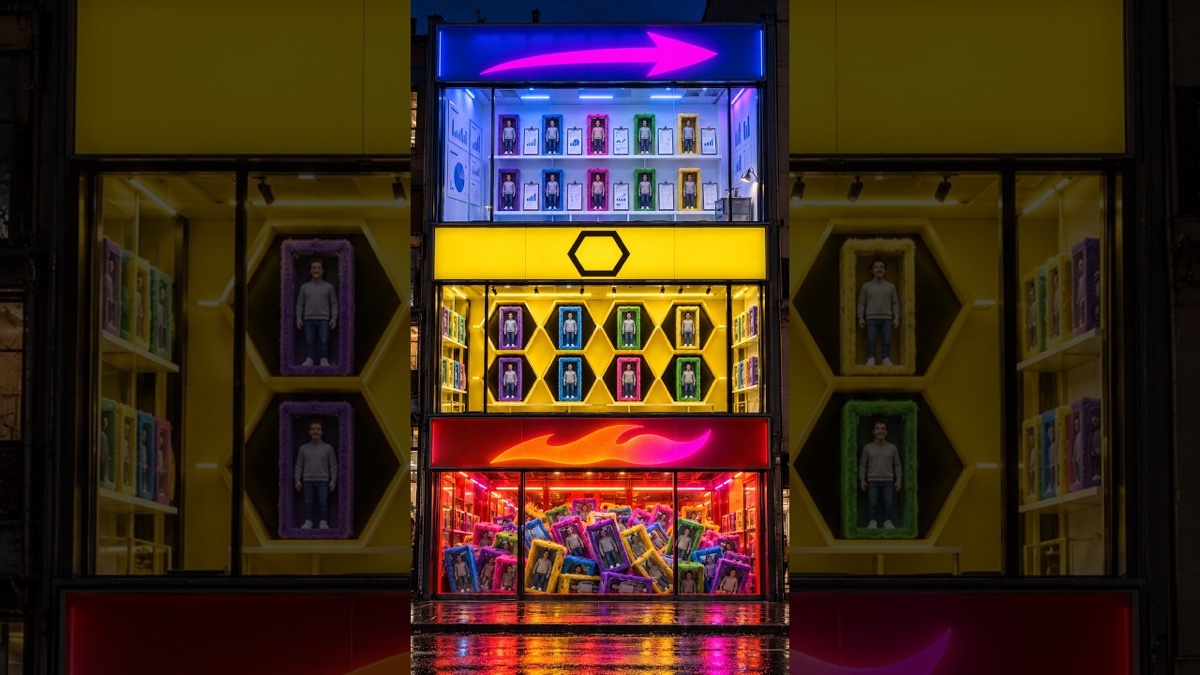
We made a short film about this. It is called I went boyfriend shopping.
The joke works because it is barely a joke.
You are on a shelf
Open a dating app as a man and look at what you are actually doing. You have a slot. You have a few photos, which are the packaging. You have a line of text, which is the label. You sit on a shelf next to several thousand other men with their own packaging and their own labels, and you wait.
She walks the aisle. She picks things up, turns them over, puts most of them back. She is not being cruel. She is shopping, because that is what the format turns the experience into, and the format was not designed by either of you.
You can change your sign. You can move to a different store, which is what people are doing when they switch from Tinder to Hinge to Bumble to whatever launched last month. You can rewrite the label. What you cannot do is make the decision. The decision is hers, it always was, and the only question on the table is whether you are still on the shelf when she makes it.
The two games are not the same game
A woman on these apps has a filtering problem. The volume arrives whether she wants it or not. Her photos can be casual, badly lit, taken at an angle nobody would choose, and the attention shows up anyway. Her work is sorting through it.
A man has a visibility problem. Nothing arrives. The attention on the men's side pools around a small group, and everyone else divides what is left over. Your photos are not competing with her expectations. They are competing with four thousand other men in the same aisle on the same evening.
This is why most dating advice is useless to you. It was written for the filtering problem. "Be yourself" is excellent advice if your difficulty is choosing between forty people who already want to meet you. It is not advice at all if nobody has picked you up off the shelf.
What bad packaging looks like
The mirror selfie is the worst packaging in the store, and not because it is tacky.
Look at it as a product on a shelf. One man. A bathroom. A phone held in front of his face so you cannot even see all of it. Nothing is happening. Nobody else is there. There is no reason given, anywhere in the frame, why a stranger should want this.
It is a box with no writing on it. She is not rejecting you when she scrolls past. She is not reading anything, because there is nothing to read.
The car in the driver's seat, the gym mirror, the sunglasses on a balcony: all the same failure. One man, alone, pointed at a camera, giving a stranger nothing to want.
What good packaging looks like
Here is the thing the shelf metaphor gets right that most advice misses. Good packaging does not mean looking more expensive. It means making the thing inside legible in half a second.
What makes a man legible is social composition: a photo where someone can see who you are, see that you are leading rather than tagging along, see something interesting happening, and read the whole frame as a moment out of your life.
That combination produces a specific reaction, and it is not admiration. It is the wish to be in that moment too. That is the reaction that stops a thumb, because it is the only one that gives her a reason to want the thing rather than merely rate it.
A photo of you alone looking good asks to be judged. A photo of you among people, leading something worth being part of, asks to be joined. Those are completely different requests and only one of them gets answered.
This is not a complaint
The market is what it is. You will not argue it into being fairer, and the men doing well in it are not doing well because they complained less.
What they have, almost without exception, is photographs that show them inside a life somebody would want to be part of. Some of them have that naturally because a friend happened to take the right picture on the right evening. Most do not, and that is an accident of who was holding the camera rather than a fact about who they are.
That accident is the thing CMeIn removes. We make social composition: you, in a real situation, with people around you, as the one the moment is organised around. The face stays yours, because the entire point is that she recognises you when you turn up.
She is still the one deciding. You just stop being invisible while she does.