How to Choose Dating Profile Photos That Feel Like You

What if the best dating profile photo isn’t your most polished one, but the one that makes it easiest to recognise you? If you’re figuring out how to choose dating profile photos, the first image can feel like a big decision. It sets the tone before anyone reads a word.
A full camera roll doesn’t always make the choice easier. You might have several similar selfies, a few flattering shots that don’t feel quite like you, and no clear sense of what each photo says at a glance. A polished image can catch someone’s eye, but if it feels staged or out of date, it may not help them picture meeting the real you.
The aim isn’t to look perfect. It’s to choose photos that make a clear, believable impression. This guide will help you assess what your first photo communicates, build a varied lineup where each image adds useful context, and spot pictures that feel confusing, outdated, or too similar. Choose by the questions each photo answers, and you’ll have a profile that feels more like you and gives the right people a clearer sense of who they might meet.
Key Takeaways
- Learn how to choose dating profile photos by judging what each image helps someone understand about you, not just how flattering it looks.
- Use clarity, credibility, variety, and conversation value to compare photos and spot which one adds more to your profile.
- Shortlist images, check that you’re recognisable, then review the set together for a natural, consistent impression.
- Plan a photo that feels comfortable rather than relying on perfect spontaneity; a natural-looking image can still be intentional.
- If your camera roll leaves a gap, consider a new dating photo that suits the role while still looking like someone a date would meet.
Table of Contents
How to Choose Dating Profile Photos That Make a Clear First Impression
Choosing a first photo can feel like a balancing act. You want to look attractive, but not so polished that the picture stops feeling like you. You want to show some personality and still be easy to recognise at a glance. A useful profile photo does one thing first: it gives someone a clear, honest impression of the person they could meet.
On a dating app, the image appears before the bio can explain the setting, the joke, or who else is in the frame. Online dating services often encourage members to add photos or videos to their profile. That makes the photo itself do useful work. Don’t make a viewer rely on hidden context to understand what they’re seeing.
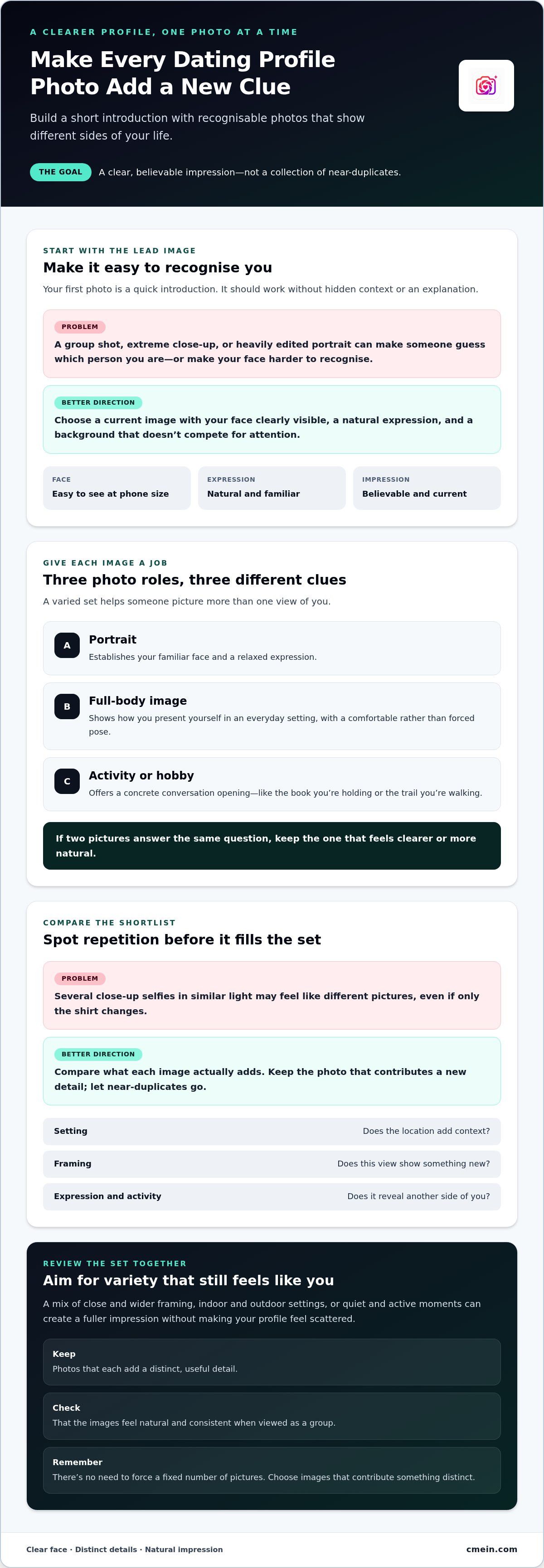
A strong first photo shows your face clearly, makes you recognisable, and captures a natural expression. Treat it as a quick introduction, not a full account of your life.
What should your first dating profile photo communicate?
Start with a clearly visible face, an expression that feels like yours, and a background that doesn’t compete for attention. One person should be identifiable without zooming, guessing, or studying the image. A group shot may be meaningful to you, but it asks a stranger to work out which person you are before they can focus on anything else.
Choose a current image rather than an extreme close-up or a heavily edited portrait. A close crop can hide how you look in a normal setting, while strong edits can blur the details people use to recognise you. Look at the photo at the size it will appear on a phone. If your face is still easy to see, the composition is doing its job.
Why a flattering photo still needs to feel believable
Looking your best and looking unlike yourself aren’t the same thing. Good light can make a photo clearer, and a thoughtful angle can feel flattering. But dramatic lighting, filters that alter your features, or a camera held very close can change how your face appears. Compare the image with how you look in an ordinary, recent photo. It should feel like the same person, not a different version built for the profile.
Believability is practical. A photo that matches the person someone expects to meet gives them less to second-guess and makes it easier to start a conversation. That doesn’t mean choosing the least flattering picture in your camera roll. It means choosing one where the good impression comes from clear light, a relaxed expression, and a recognisable face, not from effects that do too much.
To decide how to choose dating profile photos, ask one simple question about your lead image: could someone recognise you from it in a casual meeting? If the answer is clear, the photo is a useful starting point. The rest of your profile can add context, but the first image shouldn’t need an explanation.
Build a Dating Photo Set Where Every Picture Adds Something
Think of your photo set as a short introduction. Each picture should answer a different question: What do you look like in a relaxed moment? What does your everyday life include? What might someone ask you about? A set feels more revealing when the images offer distinct clues, not when every photo tries to prove the same thing.
Variety isn’t a checklist of outfits or locations. It’s useful information shown through different framing, settings, expressions, or activities. A clear portrait and a hobby photo can both be well composed, but they give a viewer different ways to picture a conversation with you.
What can different dating profile photos show?
A portrait can establish your familiar face and a relaxed expression. A full-body image can show how you present yourself in an everyday setting, as long as the pose feels comfortable rather than forced. An activity or hobby picture can offer a concrete opening, such as asking about the book you’re holding or the trail you’re walking.
Give each candidate image a job. If two pictures answer the same question, keep the one that feels clearer or more natural. You’re not trying to document every part of your life. You’re helping someone see a few real details that a bio might not convey on its own.
How to avoid a profile full of the same picture
Compare your shortlisted photos side by side. Notice the setting, crop, expression, clothing, and activity. If several are close-up selfies taken in similar light, changing shirts may not make them meaningfully different. Keep the image that adds a new detail, and let near-duplicates go.
Use this quick check for each photo:
- Setting: Does the location add context, or is it just another plain background?
- Framing: Does this view show something the other images don’t?
- Expression and activity: Does it reveal a different side of your manner or interests?
Then look at the set as a whole. A mix of close and wider framing, indoor and outdoor settings, or quiet and active moments can create a fuller impression without making the profile feel scattered. The aim is not to include a photo from every occasion. It’s to make sure each selected image earns its place.
There’s no need to force a fixed number of pictures into this decision. First choose images that contribute something distinct; for count-specific guidance, see How Many Photos Should Your Dating Profile Have? If your existing pictures leave a clear gap, AI-generated dating photos with pose guidance can help you create an image for a specific role while keeping recognisability in view.
A Simple Framework for Comparing Dating Profile Photos
When several pictures seem equally good, don’t keep switching between them based on which one feels most flattering. Give each candidate the same quick review. A simple scorecard helps you compare what a photo communicates, where it falls short, and whether it adds anything to the set.
Use these four criteria. You can mark each one as strong, mixed, or weak. The labels aren’t a scientific score. They’re a way to make your reasons for keeping or removing a photo clearer.
| Criterion | Ask yourself |
|---|---|
| Clarity | Can someone identify you and read your expression at a glance? |
| Credibility | Does the image look current and consistent with how you appear in everyday life? |
| Variety | Does it add a setting, activity, or detail that isn’t already shown? |
| Conversation value | Does it offer a natural detail someone could ask you about? |
How to judge clarity, credibility, and variety
Clarity is about what reads quickly. If your face is small, hidden, or hard to distinguish from the background, the image may be less useful than it first seemed. Credibility is about whether the photo feels like a fair picture of you now. Consider its age, editing, lighting, and context together. Variety asks what new information the image brings to the full set, not whether it features a different outfit.
Conversation value doesn’t mean every photo needs a dramatic story. A picture of you cooking, browsing a bookshop, or walking somewhere familiar might give someone an easy, specific question. A plain portrait can still be useful for clarity, even if it doesn’t offer much to talk about. Photos can have different strengths.
For example, compare a sharp portrait in a familiar setting with a more polished picture where the light is dramatic but your features look altered. The second may stand out, but the first could score better for credibility and clarity. If your set already has several portraits, the polished image may also add little variety. The strongest choice is the clearest credible image, not necessarily the most polished.
When to keep or remove a photo
Keep an image if it answers a new question about you and still feels consistent with the person shown in the rest of the profile. Set aside pictures where the subject is unclear, edits distract from your face, or the context gives a misleading impression. If two options seem close, place them side by side and compare the same criteria rather than judging each one from memory.
If you’re unsure, pause before treating that uncertainty as evidence that something is wrong with your appearance. Ask whether the picture is clear, credible, and useful to the set. A weak result on one criterion may be balanced by another, but a photo that adds little across the board is easy to remove. This is a practical way to work out how to choose dating profile photos without expecting any selection method to guarantee a particular dating outcome.
Make Your Dating Profile Photos Feel Natural, Not Staged
A relaxed-looking photo doesn’t have to happen by accident. You can choose a familiar setting, plan what you’ll do, and still look like yourself. The aim isn’t perfect spontaneity. It’s comfort: a picture that feels plausible for your life, rather than a scene you had to perform.
Use a simple review process before adding an image:
- Shortlist: Gather candidates that could fill a useful role in your profile.
- Compare: Check what each one shows, and whether another image already makes the same point.
- Check recognisability: Make sure you still look like yourself at the size the photo will appear in an app.
- Review the set: Look at the photos together. The overall impression should feel consistent, not like several different versions of you.
A practical review before adding a photo
View each candidate at phone-screen size, not just zoomed in on a large display. Check whether your expression, setting, and visible details feel consistent with real life. Then ask whether the image makes sense on its own. If the viewer needs a caption to understand what’s happening, the photo may not be doing enough work.
A useful caption can add a detail, but it shouldn’t have to explain who you are in the frame or why the image matters. For a broader review of common issues, use the checklist in Dating Profile Photo Mistakes and How to Avoid Them.
How to get relaxed photos without performing
Start with a setting or activity you already know. Make coffee, browse a market, or walk somewhere familiar. Give yourself a small action instead of holding a fixed pose: turn towards the person taking the photo, take a few steps, or talk while they shoot. Movement can ease stiffness, but it doesn’t need to become a performance.
Notice how you feel while choosing the result. If the setting looks unlike your life, your expression feels strained, or the pose depends on copying someone else, try a simpler approach. Specific posture ideas are covered in Pose Maxing: Make Your Dating Photos Feel Natural. Keep the focus on a comfortable moment you could imagine repeating, not on recreating a perfect-looking scene.
If your shortlist still lacks an image for a particular role, a new photo is one option. CMeIn creates AI-generated dating photos with pose guidance and selection advice. Choose images that remain recognisable and consistent with how you look in person. Explore CMeIn’s dating photo options.
Choose Your Final Dating Photo Set, and Fill Any Gaps
Your final set should work together, not compete for attention. Review the photos as a group for clarity, variety, credibility, and one consistent impression. Do the images show different sides of your life while still looking like the same person? If one feels out of place, you don’t have to keep it just because it’s flattering.
A final checklist for choosing dating profile photos
Use this last pass to make a decision without reopening every question:
- Recognisable opening image: Is your face easy to see, and can someone identify you without guessing?
- Distinct, believable additions: Does each other photo contribute useful information without feeling out of character?
- Clear, current impression: Remove pictures that are outdated, heavily altered, confusing, or difficult to interpret.
Then look at the lineup as a whole. A strong set doesn’t need to show every interest or mood. It should give a fair, readable sense of what meeting you might be like. This is the final step in how to choose dating profile photos: choose the images that hold up together, not just the ones that win when judged alone.
Photo choice and photo order are related, but they’re separate decisions. Once you’ve settled on the pictures, the guide Put Your Dating Profile Photos in a Strong Order covers how to arrange them.
What to do when your camera roll has a gap
A missing role is a practical gap, not a reason to use an image that misrepresents you. If the set lacks a useful everyday or activity photo, consider taking a new one in a familiar setting. Choose a place and activity that belong in your real life. The picture doesn’t need to look like an event; it just needs to add context you don’t already have.
If you’d rather not schedule a traditional photoshoot, CMeIn creates AI dating photos tailored to apps including Tinder, Bumble, and Hinge, with pose guidance and help selecting images. Any generated photo should remain recognisable and consistent with the person someone would meet. Before posting one, check the app’s current policies, including any rules about AI-generated images or disclosure.
CMeIn’s AI dating photos and selection guidance can help you create an image around a specific role in your profile. Choose one that fits the set and still feels like you.
Make Your Next Photo Choice With Confidence
Your profile doesn’t need to capture every side of you. It needs to give someone a fair starting point. If you’re still deciding how to choose dating profile photos, focus on what feels true and useful, not on building an image that could belong to anyone. You can revisit your choices as your life changes and replace a photo when it no longer feels current.
If your camera roll doesn’t have an image for the role you want to fill, you have options. CMeIn creates AI dating photos tailored to Tinder, Bumble, and Hinge, with pose and photo-selection guidance. You can create them without scheduling a traditional photoshoot. Choose images that still look recognisable and like someone you’d be comfortable meeting in person.
Explore CMeIn AI dating photos to create and choose images for your profile. Take the next step at your own pace. The right photo is one you can stand behind.
Frequently Asked Questions
Should your first dating profile photo be a close-up?
A close-up can work if it shows your face clearly without feeling cropped or distorted. Leave enough space to include your head and shoulders, and check that the camera angle doesn’t exaggerate features. For example, a photo taken at arm’s length may look different from one captured from farther away. If the close-up feels intense or unusually posed, compare it with a photo taken at a more natural distance.
Can you use a group photo on a dating profile?
Yes, a group photo can add a glimpse of your social life, but make sure it’s immediately clear which person you are. It’s easier to interpret if you’re near the centre or otherwise easy to pick out, rather than partly hidden at the edge. Consider how it reads without a caption. If someone would have to compare faces across your other pictures to identify you, choose a clearer image instead.
Are old photos okay to use on a dating profile?
Use an older photo only if it still gives a fair picture of how you look now. A different haircut or glasses may be a small change; a major shift in appearance can make the image misleading. Check more than the date: consider whether your face, build, or usual style has changed. If you’d feel the need to explain the difference before meeting, replace the photo with a current one.
Should you wear sunglasses in dating profile photos?
Sunglasses are fine in a photo that shows a real outdoor moment, but include other pictures where your eyes are visible. Eyes help people read expression and connect your face across the profile. If every image has sunglasses, it becomes harder to get a clear sense of you. Keep a sunglasses photo if it adds context, such as a day outside, rather than using it as a substitute for a clear portrait.
Can you use AI-generated photos on a dating profile?
Possibly, but first check the current rules for the app you use, including any requirements about AI-generated images or disclosure. Whatever the policy, the image should look recognisably like you and not suggest a life or appearance that isn’t yours. If an AI photo changes your features or creates a false setting, leave it out. The point is to present a believable version of yourself, not a fictional stand-in.
Should the same photos appear on Tinder, Bumble, and Hinge?
You can reuse photos across apps, but you don’t have to use an identical set everywhere. Keep images that represent you well, then choose based on the space and prompts each profile gives you. A photo that supports a particular answer or interest on one app may add less elsewhere. As you decide how to choose dating profile photos for each profile, check the full set for repeated images and make sure your overall impression stays consistent.
How often should you update dating profile photos?
Update your photos when they no longer reflect your current appearance or everyday life, rather than following an arbitrary schedule. A new haircut alone may not require a full refresh, but a major change in appearance or lifestyle can make older images less representative. Review them occasionally and ask whether you’d still feel comfortable being recognised from each one. Replace only what feels out of date; there’s no need to change a strong, accurate photo just to keep the profile looking new.