Where to Put Your Hands
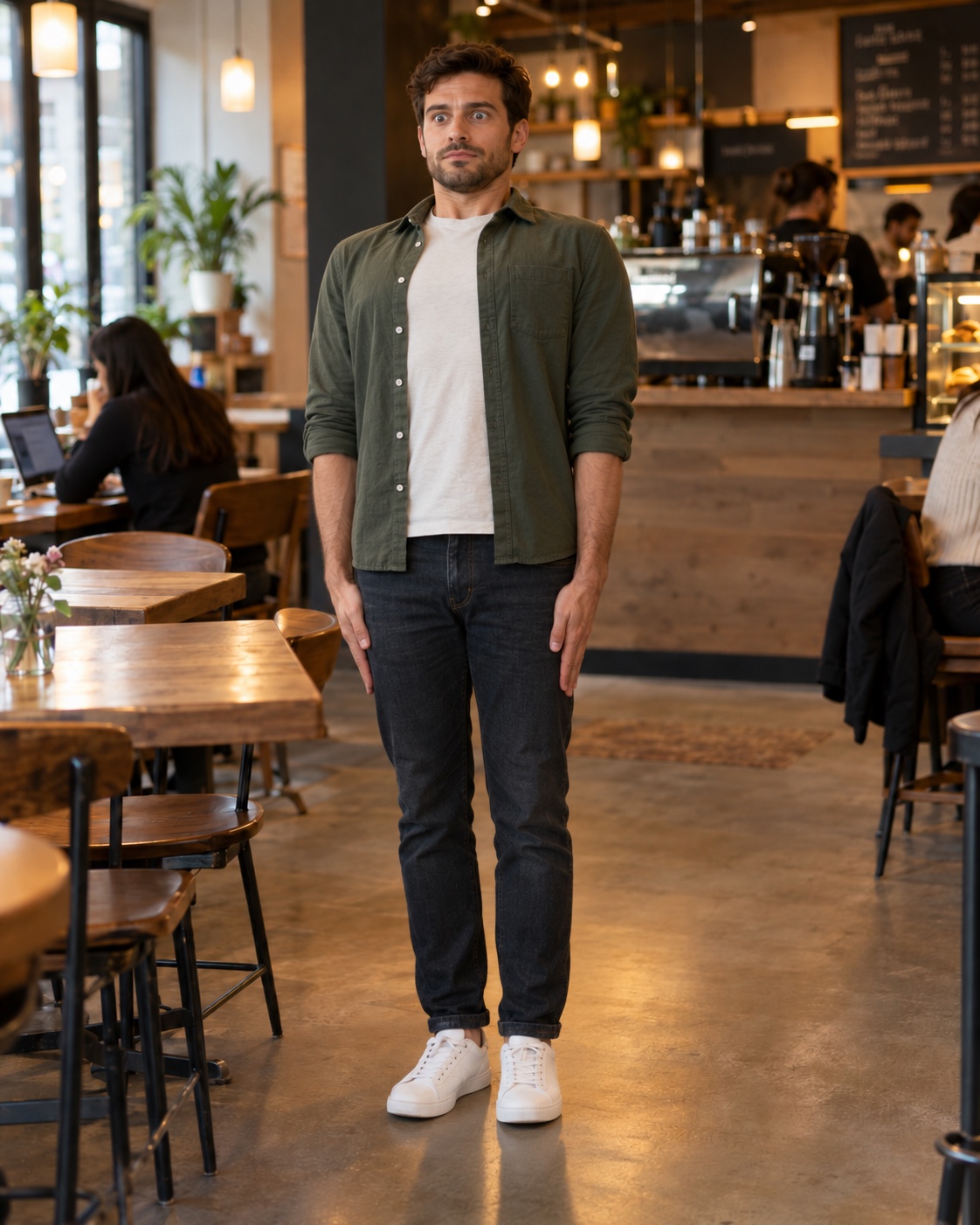
This is the part nobody is taught, and it is bigger than it looks.
We sat with dozens of photographers to put this together — not to read about posing, but to write down what they actually say out loud to a man who has gone stiff in front of a lens. What follows is the practical core of it, and at the end, an honest note about what reading it will and will not do for you.
Hands
The whole problem is that they have no job. A hand with nothing to do hangs flat against your thigh with the fingers straight, and it reads as passive — not as badly posed, as passive, which is a statement about you rather than about the photograph.
Give them something:
- A forearm resting on something — a table, a railing, a knee, the back of a chair
- Something real to hold: a cup, a glass, a strap, a book you are actually reading
- A thumb hooked outside the pocket with the rest of the hand in it
- Caught mid-adjustment — rolling a sleeve, settling a watch, pushing glasses up
The last one is the best and the least posed, because an action half-finished cannot look held.
Turn your palms edge-on. A palm flat to the lens is both the biggest surface of your hand and the nearest thing to the camera, so it is rendered large, pale and flat — and it pulls the eye off your face, which is the one thing the photograph is for. Rotate the hand so the camera sees its edge and it drops back to a normal size.
Break the symmetry. If both hands are doing the same thing at the same height, the photograph looks arranged, every time. One hand active, one quiet, at different heights. The same rule covers the classic failures: both hands buried in pockets, both hands clasped at the centre of your body, both gripping the same cup.
And let the hand continue the arm. A soft wrist, fingers gathered loosely rather than splayed or laced white-knuckled. A sharp break at the wrist is what makes a hand look like a separate object someone attached.
Chin, neck and shoulders
The instruction everybody has heard is chin up. It is backwards — it gives the lens the underside of your jaw.
Push your forehead slightly toward the camera, then lower your chin a touch. The head travels forward on the neck rather than up. It feels absurd and it photographs correctly: it sharpens the jawline and separates it from the neck, which is what people are actually trying to fix when they lift their chin.
Let your shoulders fall back and down, on an out-breath. Shoulders up near the ears read as pressure; shoulders rolled forward read as closed. This is the single correction that changes the most and the one everyone loses the instant a camera appears.
Lengthen your neck — not a stretch, just stop your head sitting down into your shoulders. And tip your upper body a very small amount toward the camera: forward reads as engaged, back reads as assessing you.
Standing
Weight onto one leg. This is the one rule to keep if you keep only one. Most of your weight on a single anchor leg, the other free — slightly forward, out to the side, or resting on the toe. It tilts the hips naturally and breaks the body out of a straight block. Weight evenly on both feet is the stance of a man standing still for a photograph, because it is.
Turn off square. Shoulders on one line facing the lens flattens you and makes you wider. Fifteen to thirty degrees of rotation, head still toward the camera, and the frame gains depth.
Unlock your knees. Locked straight reads as braced. A small bend softens the whole lower half.
Feet at a small outward angle — not parallel, not splayed. And a width that is neither pressed together nor straddled. Feet pointing in opposite directions is its own specific failure and it is surprisingly common.
Three stances that work without thinking: one foot a short step ahead of the other; ankles lightly crossed with the weight on the back leg; back heel lifted slightly onto the toe.
Sitting, which is where most photographs quietly fail
Two anchors. One for the legs and one for the arms — a forearm across a thigh, an elbow down on a knee, a hand on the edge of the seat. Without them the upper body floats, and a floating torso is the most common seated mistake there is.
Sit forward, off the back of the seat. The moment your spine touches the backrest you sink into it, your shoulders round and your torso shortens. Perch on the front third and you are upright without any effort of will. Don't let the furniture swallow you — use it.
What you sit on matters more than where. A seat that keeps your knees below your hips keeps your back honest. A low sofa folds you and no amount of posture fully recovers it. A stool, a hard chair, a step, a wall, a kerb: all better.
Break the symmetry here too. Both feet flat and level with both knees at the same angle is a frozen photograph. Draw one leg in and extend the other, or cross leg over leg, or put one foot up on the stool rail — anything that puts the knees at clearly different heights.
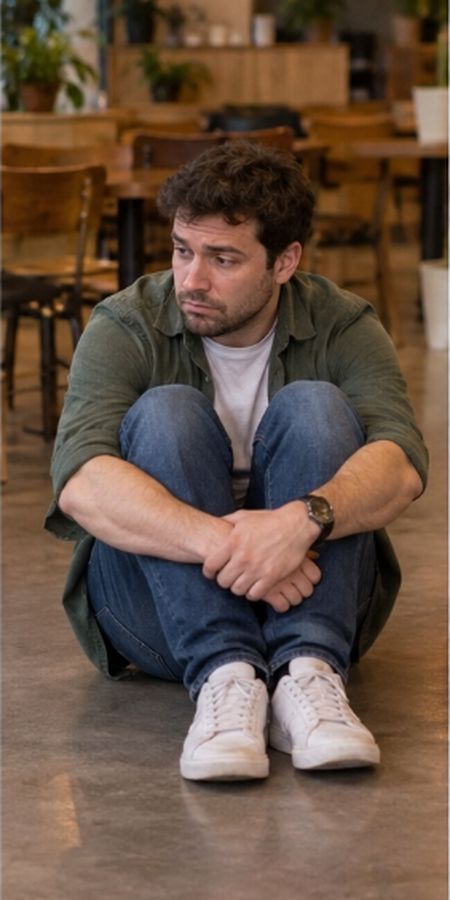
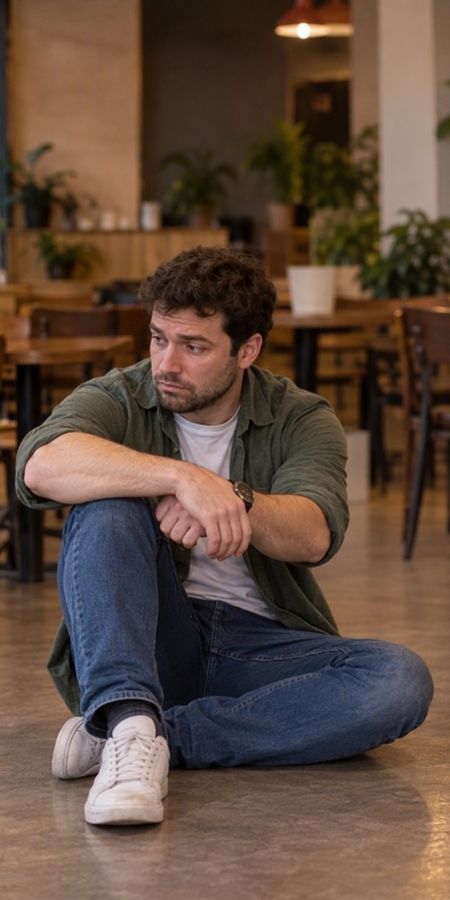
An example on the floor, which is the hardest place to sit well. Both knees pulled up and both arms wrapped around them reads as closed and cold. One knee up, one leg out, forearms resting on the raised knee: the legs are asymmetric and the arms finally have an anchor.
And turn about forty-five degrees, bringing your eyes back to the lens. Square-on seated is the most static frame there is. If there is a table, let the upper knee come slightly past its line rather than hiding both knees underneath.
Where to look
One photograph with eye contact. The rest looking at something that exists.
The rule that matters is the second half of that. A look away needs a reason in the frame. Eyes drifting off at nothing reads as vacant; eyes going to something that is actually there — the person you are talking to, the thing in your hands, the street — reads as a moment. The side gaze is the most-attempted and most-failed thing in this entire list, and the only difference between the two versions is whether there is anything on the other end of it.
Which is why actions help so much. If your hands are stirring a coffee, your eyes have somewhere legitimate to be.
Two failures worth naming: looking at your own face on the screen instead of the lens — your eyes land a centimetre low in every frame and the photograph reads as not-quite-present; and the full turn away, where the face is gone and there is nothing left to read.
Expression, briefly
A smile is judged at the eyes, not the mouth. A small, barely-there smile that reaches the eyes beats a wide one that does not, every time — and a wide one that does not is what a posed smile is, because posed smiles start at the mouth while real ones start at the eyes about a second earlier.
The most reliable trick in this entire article: move your eyes off the lens and let the smile arrive at the same moment. It stops being a smile aimed at a camera and becomes a smile that happened.
And the honest part
Read that back and count. Weight, knees, feet, shoulders, neck, chin, both hands separately, palms, symmetry, torso angle, where the eyes go, whether the look away has a reason.
You cannot run that. Not in the half-second while somebody holds up a phone and waits — and the trying is what shows. This is the strange thing about posing: the knowledge is freely available, genuinely useful, and almost impossible to apply live. It is the same reason reading about a golf swing does not give you one.
What it is good for is afterwards. Knowing this list means you can look at a photograph of yourself and finally say what is wrong instead of just that something is — and that turns out to be most of the battle, because the fix is a smaller change than you would think: the same photograph, the same place, the same people, the same clothes, with your body arranged the way it would have been if somebody competent had been standing there telling you.
Or let the list run for you: Pose Maxing measures your photo against it, shows you what it found, and fixes the pose without changing anything else.
The short version
Hands get a job and turn edge-on; the two of them never match. Forehead forward, chin down, shoulders back and down. Weight on one leg, knees unlocked, body off square. Sit forward on something hard with two anchors and your knees at different heights. One photo with eye contact, and every look away needs something real to land on.
Then accept that you will not remember any of it with a phone pointed at you — and that this is a problem with a solution rather than a personal failing.