Picturemaxxing: The Same Photo, Standing Properly
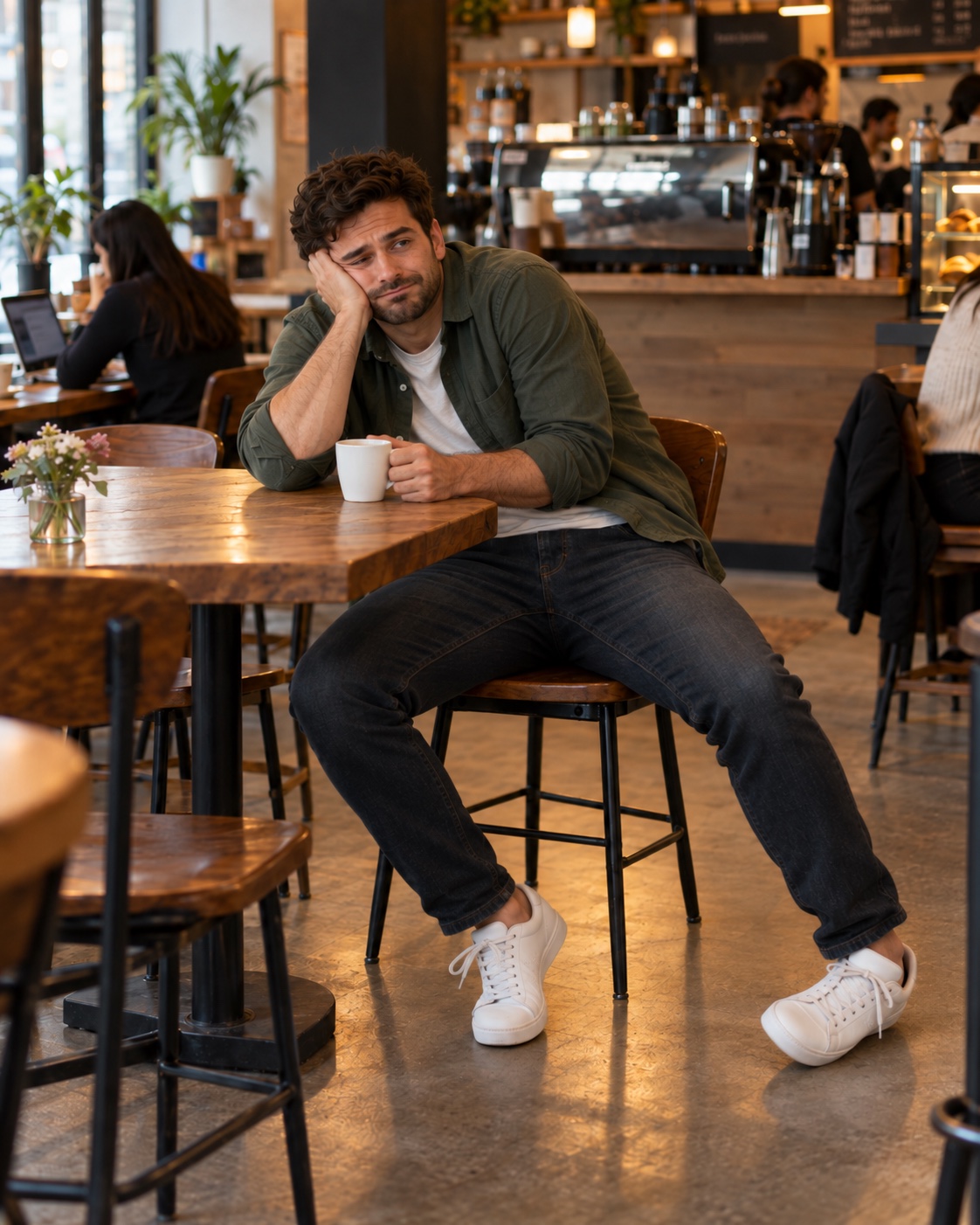
Here is a thing nobody tells you: standing still is a skill, and you were never taught it.
Not standing — standing for a camera. Where the weight goes. What the back hand is doing while the front one holds a glass. Whether your palm is facing the lens or turned edge-on. Whether both knees are locked. Whether you are square to the camera or turned fifteen degrees off it.
A good photographer makes a dozen of these corrections a minute, out loud, and most of them are a centimetre each. We sat with dozens of photographers to learn this properly and wrote down what they actually say, and the striking thing is that the list does not stop. It is a trade, with a trade's worth of detail in it, and almost none of it has ever been written down anywhere you would find it.
And then you stand in a bar on a Friday, somebody says let me get one of you, and the whole trade arrives at once as a single feeling: I don't know what to do with my hands.
The three ways out, and why two of them don't work
You could learn it. People do, and it genuinely helps — the next article is the practical version, and if you read nothing else, give your hands a job and turn them edge-on to the lens.
But knowing is not the same as doing, and here the gap is unusually wide. The corrections have to happen in the half-second before the shutter, and thinking about them is what makes a photograph look thought about. Everybody has seen the result: a person running a mental checklist, arriving at a pose that is technically correct and visibly assembled. In ordinary life your body solves all of this by itself, unsupervised, perfectly. The lens is what breaks it.
You could hire a photographer. This works. It is also the one thing you will do once.
A photographer gives you a Tuesday afternoon in good light. He does not come to the bar on Friday, on the trip in March, to the thing on Sunday where you happened to look good and somebody took a photo. The photographs that make a profile feel like a life are the ones taken where your life happens, and that is exactly where no professional is standing.
So most people end up at the third option.
The third way out, and the reason it has a bad reputation
Reach for an AI photo tool and the usual complaint in its reviews is some version of that isn't me. It is a fair complaint. We have written about it repeatedly, because it is the defining failure of this whole category: the tool quietly slims you, smooths you, straightens your face toward an average, and hands back somebody slightly better looking than you. Then you have to turn up as yourself.
But that is a decision somebody made, not a property of the technology. The model drifts toward a flattering average when nothing stops it. Something can stop it.
It is roughly the dentist problem. You can read about a filling for an hour and you still should not do your own — not because the information is secret, but because doing it is a different thing from knowing it. What you want is not a tool that redesigns your teeth. You want an expert who fixes the specific thing that is wrong and leaves the rest of your face alone, at a price that is not a wedding photographer's day rate.
That is a narrow job, and narrow is the point.
What picturemaxxing actually is
Not looksmaxxing — that word came off incel forums and it means changing the person: the jaw, the hairline, the bones. Swap one word and you get the thing that actually pays.
Picturemaxxing: the same photograph, with your body arranged properly.
Same place. Same people in it. Same clothes, same light, same evening, same face. The weight moves onto one leg. The shoulders come down and turn a few degrees off the lens. The hand that was hanging flat against your thigh gets something to do. The palm that was facing the camera turns edge-on so it stops being the biggest thing in the frame. You were sitting back into the chair; now you are sitting forward on it.
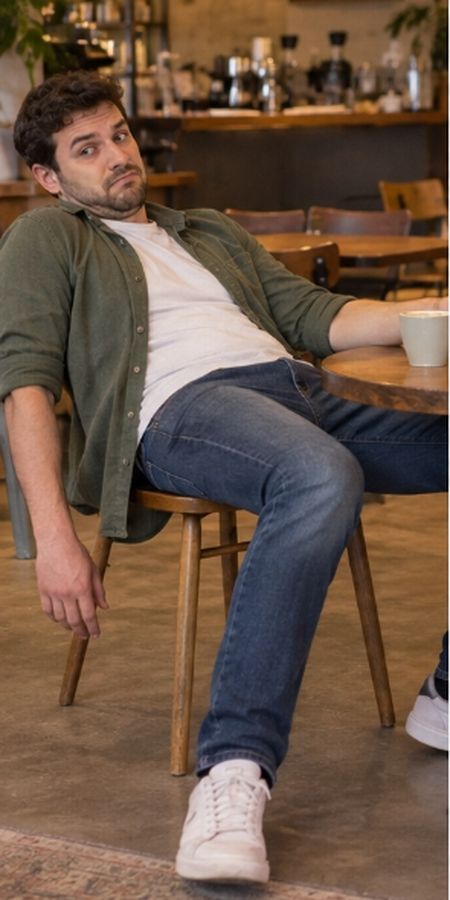
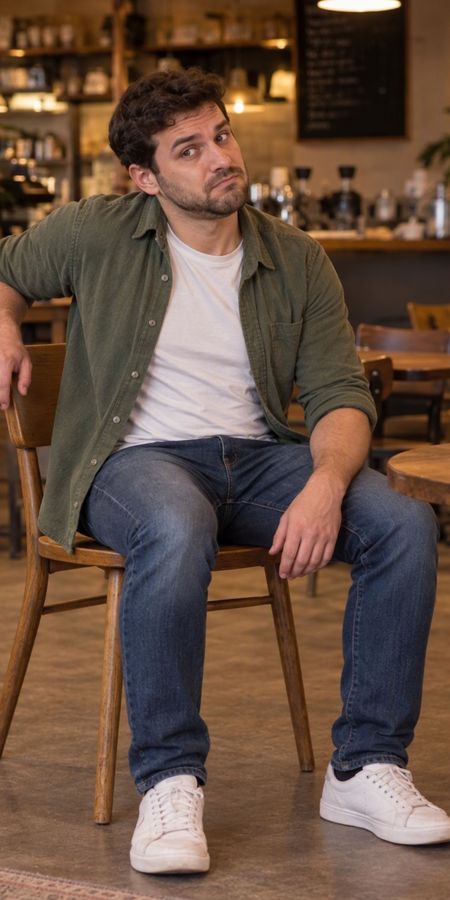
An example photo and its correction. Same cafe, same chair, same clothes, same face. He stops lying back in the chair and sits on it — upright, forward, one arm given somewhere to rest instead of hanging dead off the side.
Nothing about you changed. What your body was doing changed.
That distinction is the whole product, and it is worth being precise about, because it is exactly the line the rest of this category crosses. Slimming changes what your body is. Posture changes what your body is doing — and it is the only one of the two you could have done differently on the night.
How much difference does it make
More than it sounds like, and that is the part that is hard to believe in writing rather than in pictures.
The reason is that the errors are not subtle in their effect, only in their cause. Hands hanging dead at your sides read as passive — not "badly posed", passive, as a fact about you. Shoulders rolled forward read as braced. Both hands doing the same thing at the same height reads as staged. Locked knees read as unstable. Nobody looking at the photo thinks any of these words. They think: something's off, next.
Which means the corrections are not cosmetic adjustments to a photograph. They change what the photograph says about you — using a body you already have, in a moment that already happened.
What we do
This is what CMeIn is for, and it is why we went and sat with the photographers rather than guessing. Every correction in this article came out of those conversations — what they say to a man who has gone stiff, where they move his weight, what they put in his hand — and all of it is built into the product. That work is done. You do not have to go and do it.
Try Pose Maxing on a photo of your own — upload it, see what we spot, and pick the fixes you want.
The instruction that goes out with every generation is the part worth checking rather than trusting: do not beautify, redesign, age-shift, slim, widen, or change the face. It names what stays — face shape, hairline, skin tone, age, body proportions.
Arrangement is fair game. Proportions are not. That one sentence is the whole difference between this and the tools whose reviews say it gave me somebody else's body.
And the honest limits, both of them. A photograph where you are half out of frame, out of focus, or too far away has nothing to work with — this fixes posture, it does not invent a photograph. And a correction is a correction: it will not make a bad evening in bad light into a good photograph. It makes the photograph of that evening the one you would have got if somebody competent had been standing there saying weight on your back foot, drop your shoulders, give that hand something to hold.
Which is all a photographer was ever really doing.
The short version
Posing is a real craft with hundreds of small rules, you cannot run them in your head while somebody holds up a phone, and you are not going to bring a professional to the places your life actually happens.
What is left is a very small change to the photograph you already have: same place, same people, same clothes — standing the way you would have stood if anyone had told you.