Your AI Photos Are Ageing You. Here's Why
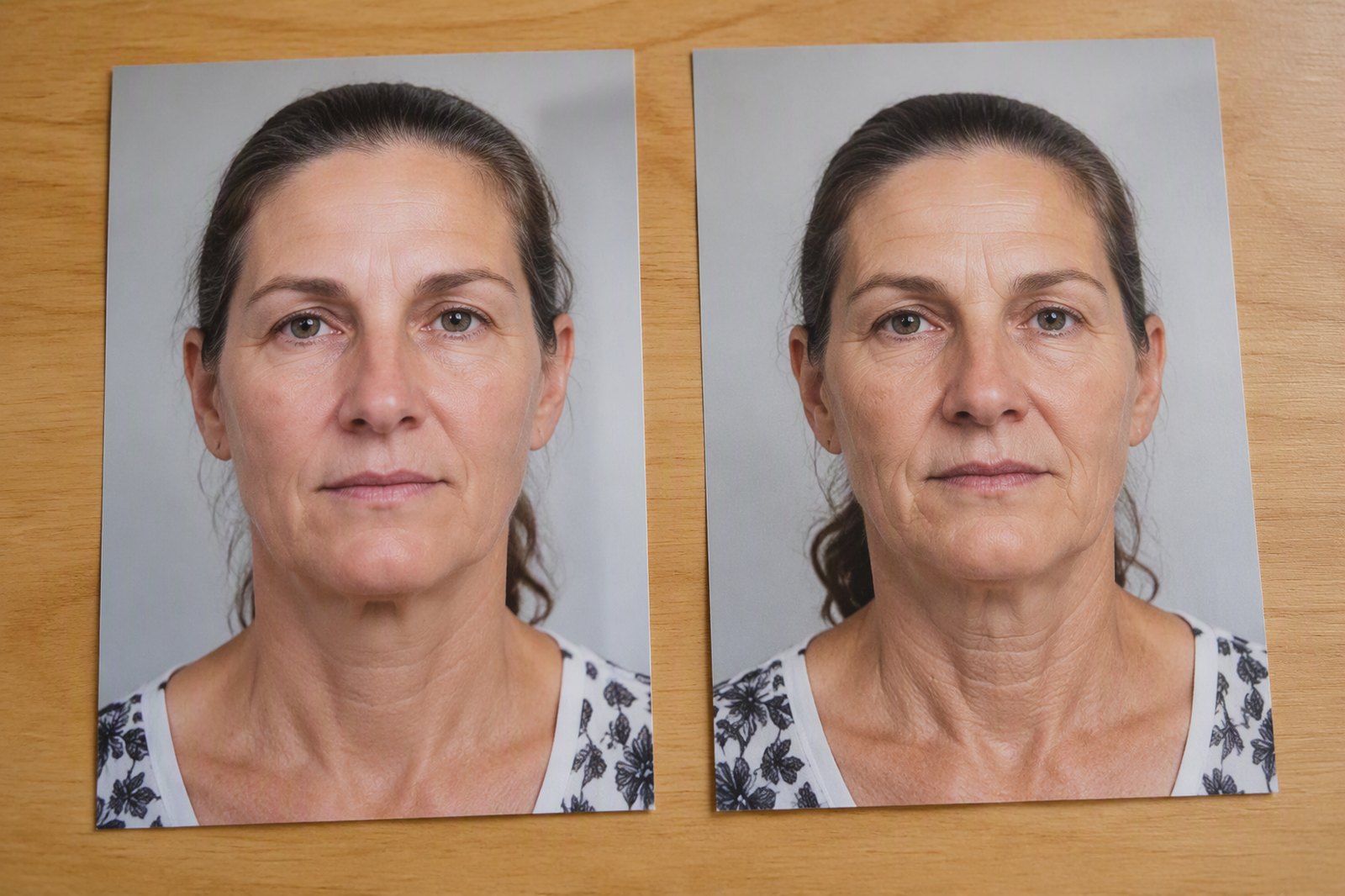
A reviewer of a large AI headshot tool, buried at the end of a longer complaint:
"If you select 41 to 50 years they automatically add long wrinkles to your neck even if you clearly don't have them."
She was not asked for a photo of herself aged up. She was asked her age range — presumably so the tool would avoid getting it wrong — and the tool used the answer as an instruction.
Forty-one to fifty means neck lines. Neck lines were applied. To a neck that did not have any.
The same mechanism, running both ways
The complaint has a mirror image in the same review sections, and it is just as common:
"One made me into a gorgeous supermodel (which sadly I am not)."
"Most of the time it reinvents you. Not everyone wants to look like a distant cousin."
One person got a decade added. The other got a decade removed. Both were replaced by an idea rather than rendered from a photograph.
That is the thing to understand: ageing and de-ageing are not two different bugs. They are the same failure — the tool generating a type instead of a person — pointing in whichever direction its inputs happened to push.
Where the added age comes from
An age field treated as a costume. The clearest case, and the most avoidable. A bracket is not a description of your face; it is a range containing millions of faces, most of which are not yours. A tool that renders "what 45 looks like" has thrown away the only useful information it had, which was your photographs.
Invented texture. When your uploads are soft, compressed or dimly lit, the model cannot see your actual skin and generates plausible skin instead. Plausible skin has texture. Texture reads as age. This is the same cause as the invented moles people complain about, expressed differently.
Hard lighting. Strong side light deepens every line you have and suggests several you do not. If your reference photos were shot under a harsh overhead lamp, the shadows came along as facial features.
Where the removed age comes from
The beautification pull. Every image model has been trained on a great deal of commercial and social photography, which is heavily retouched. Left unconstrained, it drifts toward that — smoother, more symmetrical, younger.
The prompt words you never see. Polished. Flawless. Professional headshot. None of those are neutral, and all of them have an implied age attached.
Why this matters more than it sounds
It is tempting to treat de-ageing as a free upgrade. It is the opposite, and for a specific reason.
A profile photo is checked against you in person. The more a photo improves on your face, the worse it does the one job it has, which is to be recognisable when you turn up. Ten years removed is not flattering, it is a discrepancy the other person notices in the first three seconds of meeting you.
And the added-age version is worse still: you have paid for photographs that make you look older than you are, in order to look good.
What to check
Does the tool ask your age, and what does it do with it? Compare a result to a recent real photograph, not to your idea of yourself. If it looks like a stock image of your decade, the bracket was an instruction.
Are your uploads sharp and evenly lit? Soft uploads produce invented texture; hard light produces invented lines. A window on an overcast day fixes both.
Does the tool say anything about preserving age? Most say nothing at all, which tells you it is not being held.
What we do
Age is named explicitly in the instruction that goes with every single generation: preserve the facial features, skin tone, beard, hairline, age, and overall facial structure so the result clearly still looks like the uploaded person.
Age is in that sentence as something to hold, not as a variable to style. The editing tools carry their own limit alongside it — never push an edit so far that skin tone, identity, or believability is compromised.
And the standard the whole product is built against is the one that makes both failures unacceptable: the test is whether somebody who knows your face would recognise you walking into a coffee shop. A photo that took ten years off fails that test as completely as one that added them.
The short version
Added age is usually an age field being used as a costume, plus invented texture from soft uploads. Removed age is the model's default pull toward a smoother average.
Both are the same error — a type instead of a person. And both cost you the only thing the photo was for, which is being recognised.