AI Photo Prompts for a Dating Profile (And the Words That Ruin Them)
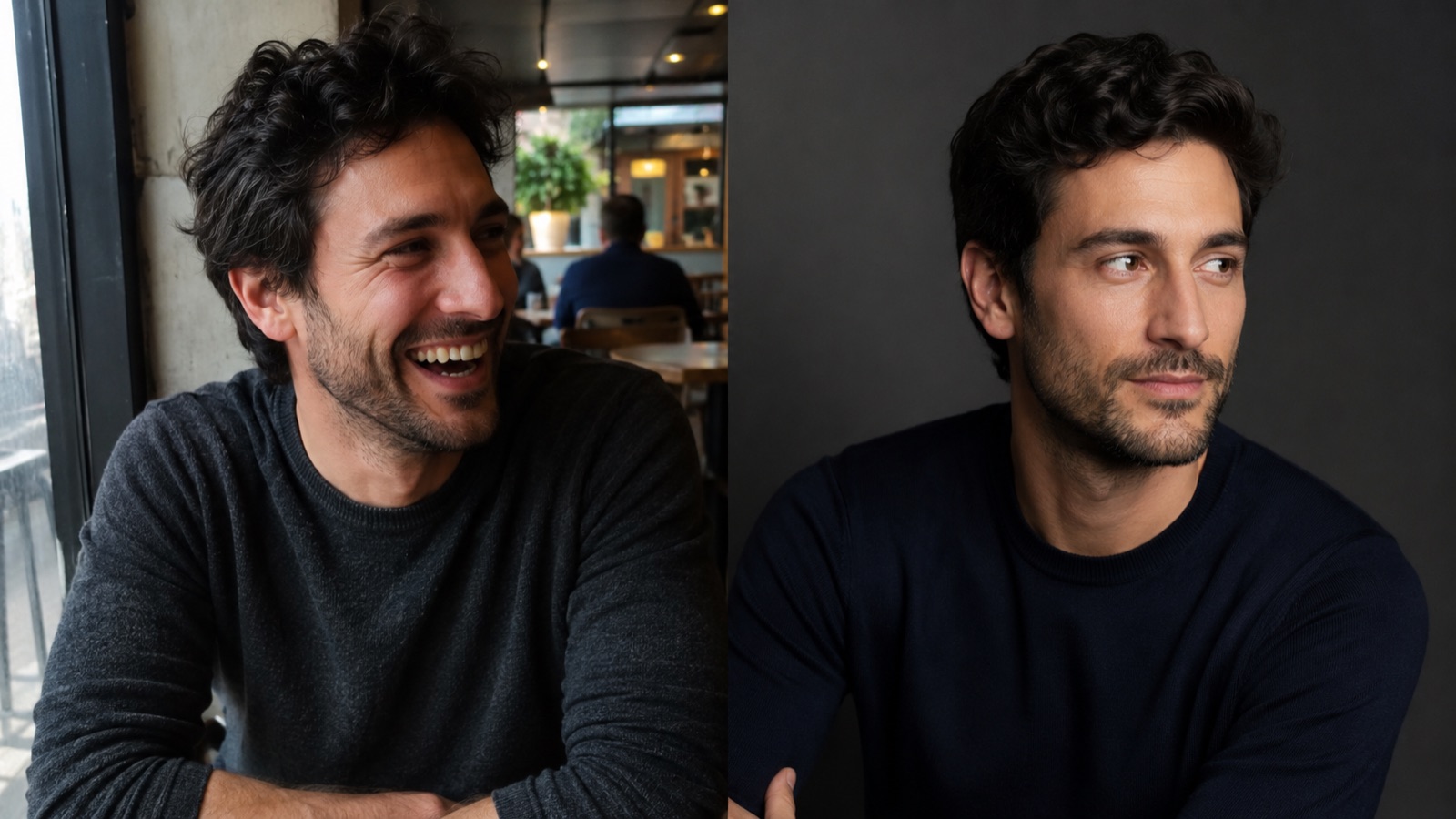
Most guides on how to write prompts for AI photos hand you the same shopping list every time: 8k, ultra-detailed, professional, cinematic lighting, masterpiece, award-winning.
Add those words and you tilt the whole image toward one place: the look people have learned to distrust.
The words aren't cursed — it's what they're attached to. Models learn from captioned images, and worse, from image sets pre-filtered for "looks good," which means glossy is already the house style before you type anything. The pictures captioned professional, cinematic and award-winning are advertising, stock photography and glamour portraits, and most people have spent the last decade learning to read that aesthetic as fake.
Which matters here for exactly one reason: on a dating app, the first question she asks isn't "is he attractive?" — it's "is this real?". Every word on that shopping list is a word that makes her ask it.
So here's the guide backwards: not what to add, but what to describe.
The anatomy of a realistic AI photo prompt (6 slots)
Fill these with nouns you could point at, not adjectives:
- Subject — age range, clothing, one or two concrete details ("worn green rain jacket," "grey t-shirt"). Not "handsome," not "attractive."
- Action — what they're doing right now, mid-motion. "Mid-laugh at something off-camera" beats "smiling," because a reason to smile produces a real face.
- Place — specific objects, not vibes. "Wooden counter, plants on the shelf" beats "cozy atmosphere."
- Light source — where it comes from, and its consequence. "Window light from the left, no hard shadows." Never "perfect lighting."
- Camera position — distance and height. Everyone writes the subject and the place; almost nobody writes where the camera was standing, and a photo with no stated viewpoint gets rendered from the default one — roughly nose-distance, dead centre, about as candid as a passport booth.
- Format — what kind of photo this is meant to be. "Ordinary phone photo, natural skin texture, horizon slightly crooked."
Notice what's missing: any word about quality. Quality words are instructions to look like a product. You want it to look like a Tuesday.
The fill-in-the-blank template
[person: age, clothing, one detail]+[verb: what they're doing, mid-action]+[place: two concrete objects]+[light: source and its effect]+[camera: distance and height]+ordinary phone photo, natural skin texture
The words that make AI photos look fake
Cut these on sight: professional, cinematic, dramatic, epic, perfect lighting, flawless skin, stunning, gorgeous, glamorous, award-winning, "model" (as in fashion model).
A note on the tag-era words — 8k, masterpiece, ultra-detailed, hyperrealistic: they moved older image models a lot and do close to nothing on today's instruction-tuned ones. They're not the danger; they're just clutter. The aesthetic words above are the real problem, and they work on every engine.
One caveat, because a rule you can't apply is useless: a bare quality word is an instruction to look like a product. A qualified one is fine — "high-quality but natural real-world photography, realistic skin texture and visible pores" is a perfectly good instruction, because the qualifier is doing the steering.
AI photo prompt examples: 4 before and after
(These assume a tool with no photo of you in it — which is the whole problem, and we'll get to it.)
Coffee shop prompt
Before: "A professional photo of a handsome man in a coffee shop, 8k, ultra detailed, perfect lighting, cinematic"
After: "A man in his early 30s in a grey t-shirt sitting at a small cafe table, holding a mug, mid-laugh at something off-camera, photographed from about three metres away at seated eye level. Window light from the left. Wooden counter and plants behind him. Ordinary phone photo, natural skin texture."
What changed: every quality word gone; a distance, a height, a light source, a reason to smile, and two real objects added.
Hiking prompt
Before: "A woman hiking on a mountain, epic landscape, golden hour, dramatic"
After: "A woman in her 30s in a worn green rain jacket walking up a dirt trail, caught mid-stride and half-turned to say something back down the path, framed from a few metres behind and slightly below her. Flat overcast light, no hard shadows. Pine trunks and loose rock along the trail, mud on her boots. Ordinary phone photo, horizon slightly crooked."
What changed: "epic" and "dramatic" gone; the frame got a position instead of a mood; the light got a consequence rather than an adjective; and the trail got two things you could actually trip on.
Street portrait prompt
Before: "Portrait of a man, studio lighting, sharp focus, professional headshot style, smiling"
After: "A man in his 30s in a navy sweater standing on a city sidewalk in the early evening, half-smiling as someone off-camera says something to him, shot from chest height about two metres back. Streetlight and shop windows on his face. Slight blur of people moving behind him."
What changed: the studio became a street, "smiling" became a cause of smiling, and the camera got a height and a distance instead of a "style" — and a headshot was never the right shape for a dating profile in the first place.
Bar prompt
Before: "A man with friends at a bar, fun atmosphere, high quality"
After: "A man in his 30s at a bar counter, half-turned on his stool and laughing at something a friend just said, one hand still on his glass. Light coming from the window behind the counter, cool and even on his face. Bottles out of focus behind him. Ordinary phone photo, taken from a stool one seat over."
What changed: "fun atmosphere" became one specific body and one specific object, and the laugh got a cause. The light also came down off the ceiling — overhead bar light drops shadows into the eye sockets and under the nose, which is exactly where a face stops looking like itself.
Troubleshooting: symptom → fix
| What you're seeing | What to change |
|---|---|
| Plastic, poreless skin | Delete every quality word; add "natural skin texture, visible pores" |
| Dead, doll-like eyes | Replace the expression adjective with a cause: "laughing at something off-camera" |
| Subject looks pasted into the scene | Name the light source once and let it apply to both — "window light from the left" |
| Face too close, selfie energy | State a distance and a height: "from about three metres, at seated eye level" |
| Background too perfect | Ask for two ordinary objects and one flaw: "mud on her boots," "horizon slightly crooked" |
| A different face every generation | Not a prompt problem — see below |
The honest problem — and the fix
Everything above controls the scene. Almost none of it controls who is standing in it.
That's the wall people hit. The light is right, the cafe is right, the framing is right — and the man in the photo is a stranger with your haircut. The next generation gives you a slightly different stranger. It's the most common complaint about AI photos of yourself, and the guides can't fix it, because they're all working on the half of the problem that's easy.
Wording has real power over likeness, but only in one direction. The wrong words will actively destroy a face — beautify, flawless, model, smooth skin will quietly hand you a generic one. No words can create a likeness the model was never properly shown. That comes from somewhere else entirely: which reference photos the system uses, how many angles and expressions they actually cover, and whether the pipeline holds your face steady when the scene changes.
That's the half CMeIn's AI dating photos are built around — and it's worth being exact, because it isn't "better prompts." You could write the prompts; you just read how. What you can't do from a text box is control which photos of you the model gets to look at. You upload a few ordinary ones — different days, different angles, no studio. The system reads which angles and expressions that set covers, picks the combination that fills the gaps, and only then writes the scene around it, following every rule on this page. What you're paying for isn't the sentence. It's the part that keeps the face the same when the cafe becomes a trail.
Try it on your own face → Credit packs from $2.99, no subscription.
If you're writing your own
Use the six slots. Delete the quality words. State a distance, name the light, give the face a reason. You'll be ahead of every guide that told you to type "8k," and for a scene, that's genuinely the whole job.
But the guides were never the thing losing you the swipe. The stranger with your haircut was — and the test was never is this a good photo. It's whether you're still recognisable when the person across the table looks up. Run it against the only face that matters: yours.