Self Hosted AI Image Generator: Complete Setup Guide 2026

Running your own self hosted AI image generator gives you complete control over your creative workflow, data privacy, and operational costs. Instead of relying on cloud-based services that process your images on remote servers, self-hosting puts the entire image generation pipeline on infrastructure you own and manage. This approach matters particularly for businesses handling sensitive visual content, teams requiring consistent availability, or organizations with specific compliance requirements that prohibit sending data to third-party platforms.
Understanding Self Hosted AI Image Generation Infrastructure
A self hosted AI image generator requires three fundamental components: computational hardware capable of running large neural networks, the model weights themselves, and software to orchestrate inference. Unlike cloud services where these elements remain invisible, self-hosting demands active management of each layer.
Hardware Requirements and GPU Selection
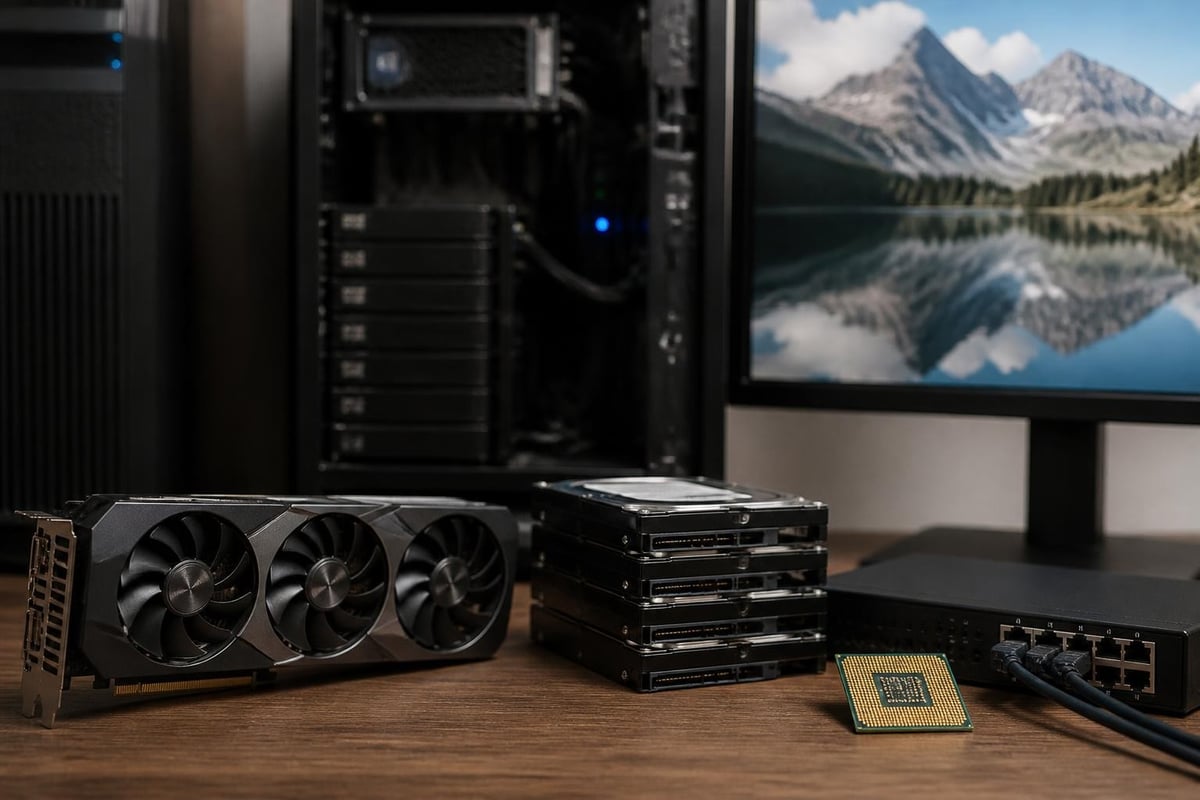
Modern diffusion models demand substantial GPU memory and computational throughput. NVIDIA GPUs currently dominate the self-hosted landscape due to mature CUDA support and optimized inference libraries. Entry-level setups typically start with RTX 4070 cards offering 12GB VRAM, sufficient for basic Stable Diffusion workflows at 512×512 resolution. Professional deployments often choose A100 or H100 datacenter GPUs for batch processing and higher-resolution output.
Key hardware considerations include:
- VRAM capacity determines maximum image resolution and batch size
- Tensor cores accelerate the matrix operations central to diffusion
- PCIe bandwidth affects model loading and multi-GPU scaling
- System RAM buffers models during loading and supports preprocessing
CPU selection matters less than GPU choice, though modern multi-core processors (AMD Ryzen 9 or Intel i9) prevent bottlenecks during image encoding and post-processing. Storage infrastructure should prioritize NVMe SSDs for model weights, with 500GB minimum capacity to accommodate multiple model variants and LoRA adapters.
Software Stack and Model Deployment
The Hugging Face Diffusers library provides the most flexible foundation for self-hosted deployments, offering programmatic control over sampling, schedulers, and pipeline customization. Installation requires Python 3.9+, PyTorch with CUDA support, and the diffusers package with its dependencies.
For teams preferring graphical interfaces, AUTOMATIC1111's Stable Diffusion WebUI delivers a complete solution with extension support, prompt weighting, and ControlNet integration. This open-source platform runs locally and provides browser-based access across your network.
| Deployment Option | Best For | Learning Curve | Customization |
|---|---|---|---|
| Diffusers Library | Developers, custom pipelines | High | Maximum |
| AUTOMATIC1111 WebUI | Teams, visual workflows | Low | High (extensions) |
| InvokeAI | Artists, production use | Medium | High |
| ComfyUI | Node-based workflows | Medium | Maximum |
Production deployments benefit from containerization using Docker, ensuring consistent environments across hardware. NVIDIA Container Toolkit enables GPU passthrough to containers, maintaining native performance while simplifying version management and rollback procedures.
Model Selection and Licensing Considerations
Choosing the right foundation model for your self hosted AI image generator involves balancing capability, licensing terms, and computational requirements. Stable Diffusion variants dominate the open-source landscape, but understanding Stability AI's licensing terms remains critical for commercial deployments.
Base Models and Fine-Tuned Variants
Stable Diffusion 1.5 continues serving as the workhorse for many self-hosted installations. Its 4GB model size loads quickly, runs efficiently on consumer hardware, and benefits from extensive community training data. SDXL (Stable Diffusion XL) delivers superior image quality and better prompt adherence but demands 16GB+ VRAM and longer inference times.
Specialized models trained for specific visual domains offer advantages over general-purpose alternatives. Realistic Vision excels at photographic outputs, while DreamShaper optimizes for artistic styles. Each model variant introduces biases toward particular aesthetics, compositions, or subject matter based on training data.
The legal landscape surrounding AI-generated content continues evolving. The U.S. Copyright Office's recent guidance on AI and copyright clarifies authorship questions and commercial rights, particularly relevant when generating images that need clear licensing for client work or commercial applications.
Training Custom Models and LoRA Adapters
Organizations with specific visual requirements often train LoRA (Low-Rank Adaptation) weights rather than full models. LoRA training requires 20-100 example images, 8-12 hours on RTX 4090 hardware, and produces compact 50-200MB files that layer atop base models. This approach proves especially valuable for maintaining brand consistency, specific character likenesses, or proprietary visual styles.
Companies like CMeIn demonstrate how specialized training pipelines maintain individual likeness across generated scenes. Their approach to creating realistic AI photos while preserving authentic facial characteristics shows what's possible when inference and training infrastructure align toward specific output goals.

Optimizing Inference Performance
Raw model deployment represents just the starting point for production-ready self hosted AI image generators. Performance optimization transforms 30-second generation times into 3-second results, directly impacting user experience and operational throughput.
Acceleration Through TensorRT and ONNX
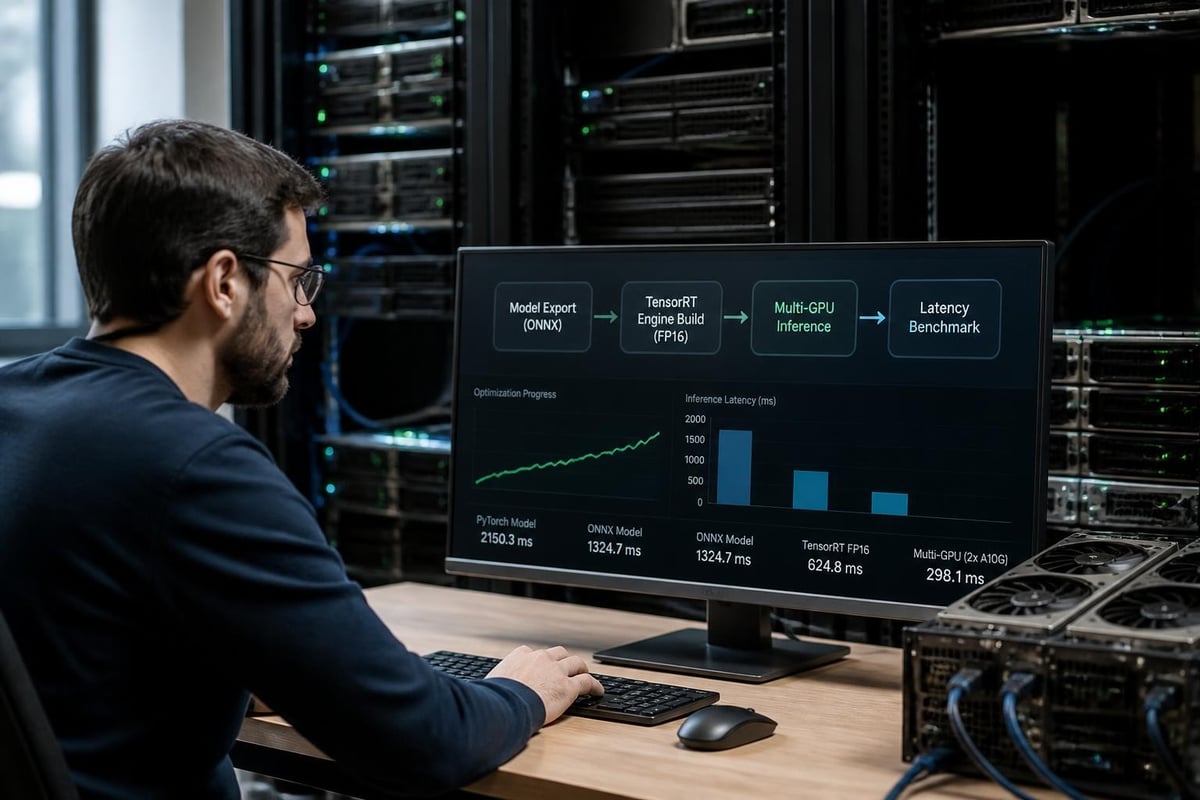
NVIDIA's TensorRT compiler converts PyTorch models into highly optimized inference engines. TensorRT conversion workflows typically involve exporting to ONNX intermediate format, then compiling TensorRT engines with FP16 precision. This two-step process delivers 2-4× speedups on NVIDIA GPUs without quality degradation.
The Hugging Face Optimum library simplifies ONNX conversion and provides ONNXRuntime integration for immediate inference acceleration. Key optimization parameters include:
- Precision mode (FP32, FP16, INT8) balancing speed and quality
- Batch size maximizing GPU utilization without memory overflow
- Dynamic shape handling for variable-resolution output
- KV-cache optimization reducing redundant attention computation
Flash Attention implementations further accelerate the attention mechanism central to diffusion models, reducing memory bandwidth bottlenecks during the denoising process. These algorithmic improvements layer atop hardware acceleration for cumulative performance gains.
Scaling Beyond Single GPU
Multi-GPU configurations enable parallel generation and higher-throughput workflows. Pipeline parallelism splits model stages across GPUs, while data parallelism processes multiple prompts simultaneously. For production deployment, NVIDIA Triton Inference Server provides enterprise-grade model serving with dynamic batching, concurrent execution, and monitoring integration.
Load balancing across GPU pools requires request routing logic that accounts for model variants, current GPU utilization, and queue depth. Simple round-robin scheduling works initially, but sophisticated deployments implement priority queues and deadline-aware scheduling for time-sensitive generation requests.
Security and Privacy Architecture
Self-hosting inherently addresses data exfiltration concerns, but comprehensive security requires deliberate architecture choices. The OWASP Secure AI Model Ops guide outlines threat models specific to ML systems, including model extraction, adversarial inputs, and training data reconstruction attacks.
Access Control and Network Isolation
Implementing proper authentication prevents unauthorized generation and resource abuse. OAuth2 integration with existing identity providers enables single sign-on while maintaining audit trails. API key authentication suits programmatic access, but requires key rotation policies and per-key rate limiting to prevent abuse.
Network segmentation isolates inference infrastructure from public internet exposure:
- Place inference servers in private VLANs accessible only through API gateways
- Use reverse proxies with WAF capabilities to filter malicious requests
- Implement mTLS for service-to-service communication
- Deploy rate limiting at multiple layers (per-user, per-IP, global)
For remote access scenarios, VPN tunnels or zero-trust network architectures provide secure connectivity without exposing inference endpoints directly. PinguProxy and similar proxy services can route external requests through controlled ingress points while maintaining IP anonymity, useful when self-hosted infrastructure needs to appear as consumer traffic for testing purposes.
Model and Data Protection
Model weights represent valuable intellectual property, particularly for custom-trained variants. Disk encryption protects models at rest, while memory isolation prevents unauthorized process access during inference. Container security best practices include non-root execution, minimal base images, and regular vulnerability scanning.
Input validation prevents adversarial prompts designed to extract training data or generate prohibited content. Content filtering layers analyze both prompts and outputs, rejecting or quarantining generations that violate policy. Logging all requests with prompt hashes enables forensic analysis without storing sensitive prompt text long-term.
European businesses requiring GDPR-compliant infrastructure benefit from providers like vBoxx, whose ISO 27001-certified data centers and European jurisdiction align with strict data residency requirements. Their infrastructure options support self-hosted deployments while maintaining compliance with privacy regulations that prohibit certain cloud services.
Deployment Patterns and Use Cases
Different applications demand different architectural approaches when building a self hosted AI image generator. Understanding these patterns helps teams avoid over-engineering simple use cases or under-provisioning production systems.
Development and Prototyping Environments
Single-developer setups often run on local workstations with consumer GPUs. Stability AI's self-hosting guide walks through initial deployment on Ubuntu systems, covering driver installation, environment configuration, and basic inference scripts.
Development workflows benefit from:
- Hot-reload capabilities for rapid model swapping
- Jupyter notebooks for experimental prompting
- Version control for prompt libraries and configuration
- Local storage for generated image archives
Production API Services
Teams building customer-facing generation features deploy self hosted AI image generators as scalable API services. FastAPI or Flask frameworks wrap inference logic, exposing RESTful endpoints that accept prompts and return images. Queue-based architectures decouple request acceptance from generation, preventing timeout issues during high load.
| Architecture Component | Development | Production |
|---|---|---|
| Compute | Single GPU workstation | Multi-GPU cluster with load balancing |
| Storage | Local SSD | Distributed object storage (S3-compatible) |
| Authentication | None or basic | OAuth2, API keys with rotation |
| Monitoring | Console logs | Prometheus, Grafana, error tracking |
| Availability | Best effort | 99.9% SLA with redundancy |
Asynchronous processing through Celery or similar task queues enables webhook callbacks when generation completes, preventing clients from holding open connections during multi-second inference cycles. Redis or RabbitMQ message brokers coordinate between web servers accepting requests and worker processes executing generation.
Batch Processing Pipelines
Content creation workflows often generate hundreds or thousands of variations exploring prompt parameters, style settings, or compositional alternatives. Batch processing maximizes GPU utilization by queuing generation tasks and processing them sequentially or in small parallel batches.
Parameter sweep automation varies elements like guidance scale, sampling steps, or seed values across fixed ranges. Grid search across prompt components tests every combination of subject descriptors, styles, and scene elements. These techniques prove valuable when optimizing prompts for specific visual outcomes, enabling systematic exploration rather than manual iteration.
Maintenance and Operational Considerations
Sustaining a production self hosted AI image generator requires ongoing attention to performance monitoring, model updates, and capacity planning. Unlike managed services where these responsibilities remain invisible, self-hosting makes operations an explicit concern.
Performance Monitoring and Debugging
Inference latency directly impacts user experience, making latency tracking essential. Instrument generation pipelines to measure time spent in each stage: prompt encoding, denoising loop iterations, VAE decoding, and post-processing. Latency percentiles (p50, p95, p99) reveal tail behavior that averages obscure.
GPU utilization metrics indicate whether hardware runs efficiently or sits idle between generations. Low utilization suggests batching opportunities or configuration issues preventing full GPU saturation. Memory usage tracking prevents OOM crashes that terminate inference mid-generation, losing progress and frustrating users.
Error rates by failure mode guide troubleshooting priority:
- CUDA out-of-memory errors indicate batch size or resolution exceeds VRAM
- Prompt parsing failures suggest input validation gaps
- Timeout errors point to insufficient generation deadline settings
- Model loading failures reveal filesystem or permission issues
Model Updates and Version Management
The AI image generation landscape evolves rapidly, with new base models, training techniques, and optimization methods appearing monthly. Tracking community developments through Hugging Face model repositories, Civitai, and research papers helps identify improvements worth integrating.
Version control for model weights using DVC (Data Version Control) or similar tools tracks which model versions generated historical outputs. This capability proves critical when debugging quality regressions or reproducing specific results. Automated testing suites run reference prompts through updated models before production deployment, catching unexpected behavior changes.
Cost Analysis and Capacity Planning
While self-hosting eliminates per-image API costs, capital expenditure and operational expenses still require analysis. GPU hardware represents 60-80% of initial investment, with server infrastructure, networking equipment, and cooling comprising the remainder.
Electricity consumption scales with GPU count and utilization. High-end datacenter GPUs consume 300-700W under load, translating to $50-150 monthly per GPU at typical commercial electricity rates. Cooling requirements add 30-50% to power consumption, particularly in rack-mounted configurations without direct ambient airflow.
Comparing self-hosted costs against cloud alternatives requires modeling actual usage patterns. High-volume scenarios with predictable load favor self-hosting, while sporadic usage often proves cheaper through pay-per-use APIs. The crossover point typically occurs between 10,000-50,000 monthly generations, depending on resolution and quality settings.
Integration Patterns and Workflow Automation
Connecting a self hosted AI image generator to broader business systems amplifies its value beyond standalone generation. Integration patterns range from simple API consumption to sophisticated feedback loops that improve results over time.
API Design and Client Libraries
RESTful APIs provide the simplest integration surface, accepting JSON payloads with prompt parameters and returning image URLs or base64-encoded data. Well-designed APIs include:
- Versioned endpoints preventing breaking changes for existing clients
- Webhook callbacks for async generation completion notifications
- Progress updates streaming generation status during long-running requests
- Batch submission accepting multiple prompts in single requests
Client libraries in popular languages (Python, JavaScript, Go) abstract API details and handle authentication, retries, and error recovery. Type-safe interfaces prevent parameter mismatches and surface available options through IDE autocomplete.
Workflow Orchestration
Modern data pipeline tools like Airflow, Prefect, or Temporal coordinate complex generation workflows involving multiple models, post-processing steps, and quality validation. DAG-based orchestration ensures dependent steps execute in proper sequence while parallelizing independent operations.
Example workflow stages include:
- Prompt preparation from templates and user input
- Initial generation using base model
- Upscaling for higher resolution output
- Face correction using specialized restoration models
- Quality scoring filtering low-quality outputs
- Storage archiving approved images with metadata
Conditional branching enables adaptive workflows that adjust parameters based on intermediate results. If quality scoring flags issues with initial generation, retry logic can adjust guidance scale or sampling steps before proceeding.
Continuous Improvement Through Feedback
Production systems collecting user feedback on generated images create training datasets for model fine-tuning. Binary ratings (thumbs up/down), detailed quality assessments, or actual usage patterns (which images users ultimately select) all signal generation quality.
Platforms like CMeIn that generate photos requiring authentic likeness preservation must balance general image quality with individual feature accuracy. Their photo review capabilities assess both technical merit and contextual appropriateness, providing the multi-dimensional feedback needed to optimize specialized models.

For developers and businesses needing secure, low-latency connections between distributed components, understanding network infrastructure becomes critical. Resources like JohnnysNewsletter provide practical cybersecurity guidance relevant to self-hosted systems handling visual data and user information.
Advanced Techniques and Emerging Capabilities
The foundational knowledge of deploying a self hosted AI image generator opens doors to advanced capabilities that push beyond standard text-to-image workflows. These techniques leverage the flexibility of self-hosted infrastructure in ways cloud APIs rarely expose.
ControlNet and Spatial Guidance
ControlNet architectures add spatial control to diffusion models through edge maps, depth maps, pose skeletons, or segmentation masks. Self-hosted deployments can chain multiple ControlNet models, applying both pose guidance and depth control simultaneously for precise compositional control.
Training custom ControlNet models requires paired datasets showing input conditions and desired outputs. Domain-specific control models learn to respect architectural blueprints, clothing sketches, or branded style guides. This capability proves valuable for businesses with exacting visual requirements that general models cannot satisfy.
Inpainting and Outpainting
Selective regeneration through inpainting masks enables precise editing of existing images while preserving unmasked regions. Self-hosted implementations give complete control over mask generation, blending parameters, and multi-pass refinement. Outpainting extends images beyond original boundaries, creating wider compositions or filling cropped edges.
Production inpainting workflows often combine object detection, segmentation models, and inpainting in automated pipelines. Detecting faces or products, generating precision masks, and selectively regenerating those regions enables targeted quality improvement without full image regeneration.
Multi-Model Ensembles
Running multiple specialized models and combining outputs produces results superior to any single model. Ensemble approaches include:
- Result blending averaging outputs from different models
- Best-of-N selection generating multiple candidates and selecting highest-scoring
- Sequential refinement using one model's output as another's starting point
- Feature combination merging strengths of specialized models
These techniques demand substantial compute resources, making self-hosted infrastructure with multiple GPUs particularly valuable. Cloud API costs for generating 5-10 variations per prompt quickly exceed self-hosted amortized costs at production scale.
Self-hosting an AI image generator delivers control, privacy, and cost efficiency for organizations with consistent generation needs and technical capabilities. The infrastructure investment pays dividends through customization options, data sovereignty, and performance tuning unavailable in managed services. Whether you need production-scale batch processing or specialized fine-tuning for specific visual requirements, self-hosted deployments provide the foundation for sophisticated image generation workflows. CMeIn shows what's possible when generation infrastructure focuses on authentic representation, creating realistic photos that maintain your true likeness across diverse scenes without artificial enhancement.