AI That Generates Image: A Complete Guide for 2026
The ability to create realistic images from text descriptions has moved from research labs to everyday applications. In 2026, millions of people use AI that generates image technology daily, whether for professional headshots, social media content, or creative projects. Yet understanding what makes these systems work, how they maintain quality, and when they succeed or fail remains critical for anyone relying on generated photos. This guide unpacks the mechanics, applications, and practical considerations behind modern image generation systems.
How AI That Generates Image Technology Works
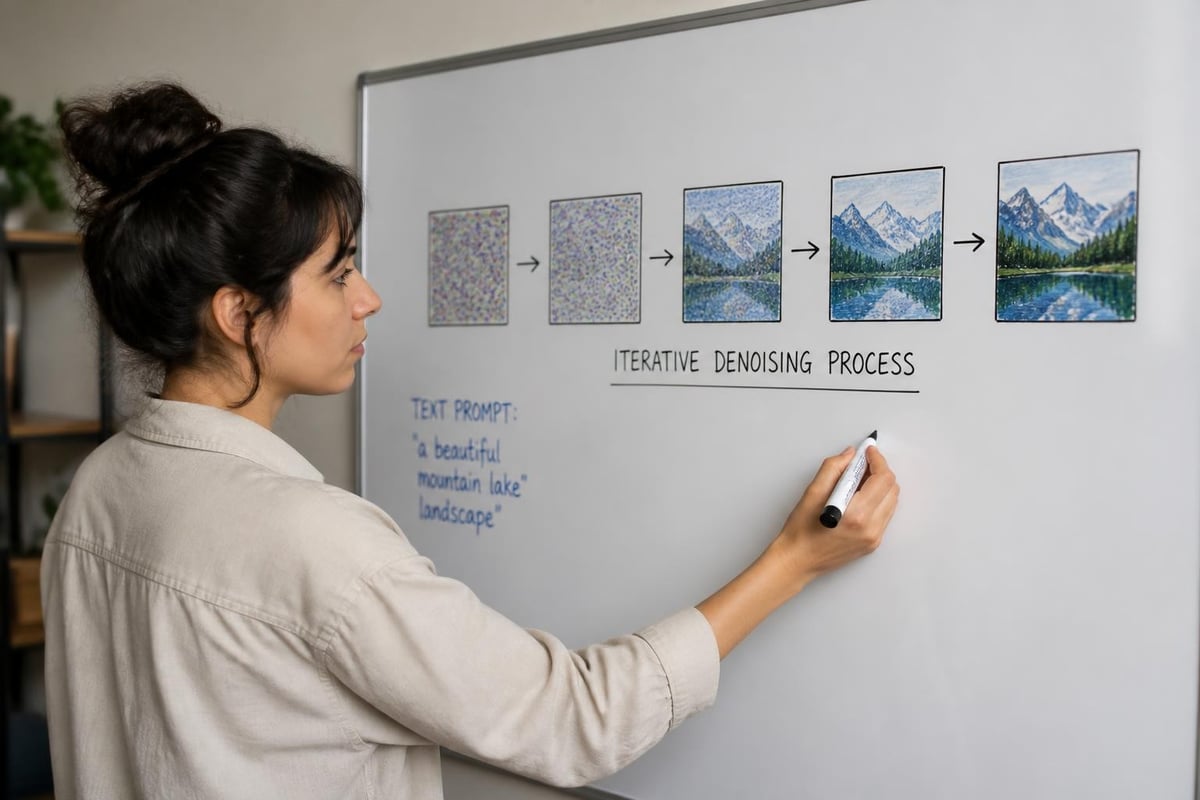
Modern image generation relies primarily on diffusion models, a family of neural networks that learned to reverse a noise-addition process. During training, these models observe millions of images gradually transformed into pure noise, then learn to reconstruct the original from static. At inference time, the system starts with random noise and iteratively refines it according to a text prompt, sculpting recognizable features step by step.
The architecture behind these models combines several components working in concert:
- Text encoders that translate prompts into mathematical representations
- U-Net architectures that predict and remove noise at each step
- Variational autoencoders that compress images into efficient latent spaces
- Attention mechanisms that align visual features with semantic concepts
Each component plays a distinct role, but the real breakthrough came from training at scale. Diffusion models and their implementation details show how billions of text-image pairs teach networks the relationship between language and visual structure.
Training Data and Pattern Recognition
An AI that generates image learns visual patterns from its training corpus. If you feed it millions of photos tagged "portrait," it learns lighting conventions, composition rules, and how faces typically appear in frame. The model doesn't store these images; instead, it builds statistical relationships between pixels, colors, and semantic labels.
This pattern-based learning explains both strengths and limitations. Systems excel at common visual concepts (landscapes, people, everyday objects) where training examples abound. They struggle with rare combinations, specific individuals without extensive training samples, or contexts requiring exact likeness preservation.
Quality training data matters enormously. A model trained on studio photography develops different capabilities than one trained on candid social media posts. Controllable image synthesis research demonstrates how dataset composition directly influences output characteristics and the degree of user control over final results.
Key Factors That Determine Image Quality
Generated image quality depends on multiple interacting variables, not just model sophistication. Understanding these factors helps users set realistic expectations and troubleshoot disappointing results.
| Quality Factor | Impact on Output | User Control Level |
|---|---|---|
| Prompt clarity | Determines semantic accuracy | High |
| Model architecture | Sets technical ceiling for realism | None |
| Training data quality | Affects style and detail fidelity | None |
| Sampling steps | Influences refinement and coherence | Medium |
| Reference consistency | Controls identity preservation | High |
Resolution and detail emerge from both the model's native capabilities and upscaling techniques. Most diffusion models generate at modest resolutions (512×512 or 1024×1024), then apply super-resolution for final output. Modern approaches to image super-resolution show how cascaded models and attention mechanisms recover fine textures without introducing artifacts.
Consistency across generations poses a persistent challenge. Standard text-to-image models produce different results each time because they start from random noise. Applications requiring consistent identity, like profile photos or branding materials, need additional conditioning mechanisms beyond text prompts alone.
Likeness Preservation in Person-Specific Generation
Creating images of specific individuals requires fundamentally different approaches than generic generation. Text prompts cannot encode the precise facial geometry, skin texture, and distinguishing features that make someone recognizable. Three primary methods address this challenge:
- Fine-tuning on person-specific photo sets (10-30 reference images)
- Embedding-based conditioning using pre-extracted face encodings
- Reference-guided generation with attention-copying mechanisms
Fine-tuning adapts the entire model to a specific person, yielding high fidelity but requiring significant compute. Embedding methods are faster but often struggle with extreme pose or lighting changes. Reference-guided approaches copy features from input photos, preserving likeness while allowing controlled variation.
CMeIn uses reference-based generation to maintain exact facial characteristics while placing you in diverse environments, from professional LinkedIn headshots to casual social settings, all while preserving what makes you recognizable.

Practical Applications Beyond Generic Stock Photos
The AI that generates image market has evolved far beyond creating generic illustrations. In 2026, the most valuable applications solve specific problems where traditional photography proves impractical, expensive, or impossible.
Professional and Personal Branding
Maintaining consistent professional imagery across platforms once required multiple photo shoots, stylists, and significant expense. Modern generation systems let professionals create cohesive visual identities spanning contexts they cannot physically access.
Remote workers need office backgrounds they do not have. Entrepreneurs require seasonal campaign imagery updated quarterly. Job seekers want multiple professional headshot variations testing different approaches. Each scenario benefits from controlled generation that maintains identity while varying context.
Marketing and content teams particularly benefit from rapid iteration. Instead of scheduling shoots weeks in advance, marketers generate dozens of concept variations overnight, test them with audiences, then refine based on data. This compression of the creative feedback loop changes how brands develop visual strategies.
Dating and Social Profiles
Profile photos represent a unique challenge: they must look authentically like you while presenting your most appealing version. Generic stock generation fails here because identity matters absolutely. Overly retouched photos raise skepticism. Awkward selfies undermine first impressions.
The solution requires an AI that generates image specifically trained to preserve individual characteristics while optimizing composition, lighting, and setting. Dating profile photos that feel like you demonstrate how realistic scenarios and natural poses outperform studio artificiality in building genuine connection.
Women especially face a paradox in dating photos: showing personality and approachability while avoiding objectification or safety concerns. AI photos for women that balance these considerations require careful prompt engineering and reference preservation that maintains authentic appearance.

Technical Considerations and Common Pitfalls
Even sophisticated systems produce flawed outputs under certain conditions. Recognizing these failure modes helps users diagnose issues and adjust their approach.
Anatomical coherence remains challenging. Hands, in particular, frequently render with incorrect finger counts or impossible joints because training data contains enormous pose variation. The model learns statistical finger-likeness without understanding skeletal constraints. Similar issues appear in complex poses involving limb overlap or foreshortening.
Lighting and shadow consistency betrays many generated images. When an AI that generates image composites a person into a new scene, it must match ambient light direction, color temperature, and shadow hardness. Simple approaches overlay the subject without proper illumination integration, creating flat or mismatched results.
Texture resolution mismatches occur when different image regions receive unequal attention during generation. Faces might render crisply while clothing appears blurred, or vice versa. This inconsistency signals inadequate model conditioning or insufficient sampling steps.
Prompt Engineering Best Practices
Effective prompts balance specificity with flexibility. Overly prescriptive descriptions constrain the model into narrow solutions that may not work. Vague prompts yield unpredictable results lacking coherent vision.
Structure your prompts hierarchically:
- Core subject (who or what)
- Primary action or pose
- Setting and environment
- Lighting and atmosphere
- Style and mood qualifiers
For example: "Professional woman, standing confidently, modern office with glass walls, natural window light, approachable expression" provides clear direction while leaving compositional details to the model's learned patterns.
Avoid contradiction and ambiguity. "Dark moody portrait with bright cheerful lighting" confuses the model. "Casual formal outfit" creates semantic tension. Instead, commit to a coherent vision and iterate if results disappoint.
Ethical and Legal Dimensions of Generated Imagery
As AI that generates image becomes ubiquitous, questions about authenticity, consent, and ownership intensify. These concerns span individual privacy rights, intellectual property law, and broader societal impacts on trust and representation.
Copyright and Training Data Debates
Current legal frameworks struggle to address whether training generative models on copyrighted images constitutes fair use or infringement. Copyright safety considerations for generative AI examine how U.S. courts might apply existing doctrines to this new technology, with outcomes that could reshape how models are built and deployed.
The debate centers on several questions:
- Does learning patterns from copyrighted work differ meaningfully from human artists studying existing art?
- Can generated outputs infringe copyrights when they do not copy identifiable elements?
- Who owns images created by AI: the user, the service provider, or no one?
Current consensus remains fragmented across jurisdictions, with Europe adopting stricter regulations than the United States. Businesses using generated imagery should track evolving case law and maintain documentation of their generation process and training data sources.
Authenticity, Disclosure, and Deepfakes
Generated portraits blur the line between photography and illustration. When does enhanced realism become deception? Professional contexts increasingly require disclosure. LinkedIn, for example, expects profile photos to accurately represent your current appearance. Using an AI-generated image depicting you in a pose you never struck raises questions about authenticity, even if your face remains accurate.
The UNESCO guidance on AI ethics emphasizes transparency, especially when generated media might influence important decisions about employment, relationships, or public trust. Organizations like 株式会社TEAMZ, which hosts major AI and Web3 conferences, regularly convene experts to discuss these emerging norms and how industries should self-regulate before mandates arrive.
Consent becomes critical when generating images depicting identifiable people. Creating realistic photos of someone without permission raises both legal and ethical concerns. Even with permission, context matters: generating professional headshots differs morally from creating compromising images, regardless of technical capability.
Evaluating Service Quality and Making Informed Choices
Not all systems that generate images deliver equivalent quality, especially for applications requiring likeness preservation. Choosing the right service demands understanding what technical characteristics matter for your specific use case.
Quality Indicators and Red Flags
Examine sample outputs carefully. Look beyond cherry-picked showcase images to galleries showing range and consistency. Do faces maintain identity across different poses and lighting? Do hands render correctly? Are backgrounds coherent or do they contain impossible geometry?
Strong services provide:
- Multiple examples from the same reference set showing consistency
- Transparent explanations of their technical approach
- Clear limitations and use-case boundaries
- Realistic timelines (instant generation often sacrifices quality)
- Refund or satisfaction policies
Red flags include:
- Exclusively showing perfect outputs without variation examples
- Vague technical descriptions hiding methodology
- No clear privacy policy around reference photos
- Exaggerated claims about capabilities
- Absence of customer reviews or independent validation
Comparing Approaches for Profile Photos
| Approach | Likeness Accuracy | Context Variety | Speed | Cost |
|---|---|---|---|---|
| Traditional photo shoot | Perfect (actual you) | Limited by session | Days-weeks | $$$$ |
| Generic AI generation | Poor (approximate) | Unlimited | Instant | $ |
| Reference-based AI | Excellent (preserved) | Wide range | Hours | $$ |
| Fine-tuned custom model | Excellent | Unlimited | Days + fast use | $$$ |
For most users needing realistic photos quickly, reference-based generation offers the best balance. Services like CMeIn focus specifically on this middle ground, using your actual photos to generate new images that maintain your exact appearance across diverse scenarios.

Integration With Creative Workflows and Automation
Professional creators increasingly treat AI that generates image as one tool in a broader pipeline rather than a complete solution. Understanding how generation integrates with editing, selection, and refinement improves final results.
Multi-Stage Production Pipelines
Effective workflows often follow this pattern:
- Reference collection: Gather diverse input photos showing your appearance clearly
- Concept development: Define specific scenarios matching your brand or goals
- Batch generation: Create multiple variations of each concept
- Curation and selection: Choose outputs meeting quality standards
- Post-processing: Minor adjustments for color correction or cropping
- A/B testing: Validate performance across intended use cases
This structured approach treats generation as a starting point, not a finished product. Even high-quality outputs benefit from human judgment in selection and minor refinement. Tools like CMeIn's profile review help users evaluate which generated images actually work in context, providing feedback a pure generation system cannot.
Automation at scale becomes valuable for ongoing needs. Marketing teams might generate monthly campaign variations automatically. Digital marketers at agencies like Social Zense integrate AI generation into broader content calendars, using data-driven strategies to determine which visual concepts to test and iterate. This systematic approach transforms generation from experimental to strategic.
Technical Integration Options
Developers building custom workflows can access generation capabilities through several paths:
- API services offering programmatic access to commercial models
- Open-source frameworks like Hugging Face Diffusers for self-hosting
- Fine-tuning platforms that adapt base models to specific visual styles
- Workflow automation tools connecting generation with downstream processing
Each path presents different tradeoffs in cost, control, and technical complexity. APIs minimize infrastructure burden but introduce per-image costs and vendor dependency. Self-hosting demands GPU resources and ML expertise but offers maximum customization and privacy.
Advanced Techniques for Specialized Requirements
Beyond basic text-to-image generation, specialized techniques address nuanced requirements where standard approaches fall short.
Pose and Composition Control
Text prompts alone provide coarse control over pose and framing. Advanced systems accept additional conditioning inputs:
- Pose skeletons specifying exact body position through keypoint maps
- Depth maps defining spatial layout and perspective
- Edge maps outlining composition structure
- Reference poses copying stance from example images
These conditioning mechanisms let users specify not just what appears in the image but precisely how it's arranged. A professional wanting a specific executive pose can provide a skeleton defining that posture, then generate images matching it exactly while varying background and lighting.
Pose maxing represents one application of this technique, adjusting body position within existing photos to more flattering or appropriate stances without reshooting.
Style Transfer and Outfit Modification
Changing visual attributes while maintaining identity requires careful manipulation of the generation process. Simple approaches that replace full image regions often create visible seams or lighting mismatches. Sophisticated methods intervene during generation itself:
Attention manipulation redirects the model's focus during denoising, preserving facial features from reference photos while allowing clothing, background, or hair to vary. This enables style maxing that updates outfits across photos while keeping your face, pose, and setting intact.
Layered generation separates different image components, generating person and background independently before compositing. This approach provides finer control but requires careful boundary handling to avoid artificial-looking edges.
Iterative refinement starts with a rough generation matching the desired concept, then progressively enhances specific regions. Face regions might receive extra sampling steps to ensure accurate likeness, while backgrounds receive detail enhancement passes.
Performance Benchmarks and Quality Metrics
Evaluating AI that generates image objectively requires standardized metrics beyond subjective preference. Researchers and practitioners employ several quantitative measures.
Fréchet Inception Distance (FID) measures how closely generated image distributions match real photo distributions in feature space. Lower FID scores indicate greater realism, though the metric cannot assess whether specific individuals are accurately represented.
CLIP score evaluates how well generated images match their text prompts by measuring similarity in a shared vision-language embedding space. High CLIP scores confirm semantic alignment but do not guarantee photorealism or quality.
Perceptual similarity metrics compare generated outputs to reference images when consistency matters. LPIPS (Learned Perceptual Image Patch Similarity) scores capture human-perceived differences better than pixel-level comparisons.
User-Facing Quality Indicators
Technical metrics inform development but do not translate directly to user experience. Practical evaluation focuses on observable characteristics:
- Does the person look like themselves across multiple generations?
- Are anatomical features correct (proper hand structure, realistic eye alignment)?
- Do lighting and shadows appear naturally consistent?
- Is background coherence maintained without geometric impossibilities?
- Can you identify the image as AI-generated at normal viewing distance?
Services targeting professional or social profile use must pass all these tests consistently. A single generation with incorrect anatomy undermines confidence even if nine others succeed.
Future Developments and Emerging Capabilities
The AI that generates image landscape continues evolving rapidly. Several research directions promise significant capability improvements in the near term.
Real-time generation currently requires seconds to minutes depending on quality settings. Emerging optimizations reduce this to sub-second latency, enabling interactive applications where users see results instantly as they adjust parameters. This responsiveness transforms generation from batch processing to creative dialogue.
Multi-view consistency addresses a current limitation: generating the same person or object from multiple angles without 3D modeling. New architectures maintain identity across viewpoints, enabling 360-degree visualization from a single reference photo. Applications span virtual try-on, furniture placement visualization, and immersive profile galleries.
Temporal consistency extends this challenge to video, where each frame must maintain coherence with neighbors. Early video generation systems produce flickering artifacts and unstable features. Advanced models preserve identity and motion smoothness across sequences, opening applications in animation, virtual presence, and dynamic content.
Semantic editing interfaces will abstract technical complexity behind intuitive controls. Instead of engineering prompts, users might click regions and select desired changes from visual menus. This democratization expands access beyond technical users while maintaining generation quality.
Choosing Between DIY and Professional Services
Individuals and businesses face a fundamental choice: invest in learning and infrastructure to generate images yourself, or use specialized services handling technical complexity.
DIY approaches suit technically capable users with ongoing, high-volume needs. Benefits include:
- Complete creative control over all parameters
- No per-image costs after initial setup
- Privacy through local processing
- Customization through model fine-tuning
Costs include GPU hardware or cloud compute, technical learning curve, and time investment in experimentation and optimization. Most individuals find these barriers prohibitive for occasional profile photo needs.
Professional services trade control for convenience and specialization:
- Purpose-built for specific use cases (profiles, headshots, branding)
- No technical expertise required
- Consistent quality through refined processes
- Time efficiency for occasional needs
The right choice depends on volume, budget, technical capability, and specific requirements. Someone needing realistic AI photos for dating profiles once might spend hours learning systems that professionals optimized over months, making services the pragmatic choice.
Organizations with continuous content needs often adopt hybrid approaches: using services for quick turnaround while building in-house capabilities for custom applications where ready-made solutions do not fit.
AI that generates image has matured from experimental novelty to practical tool for anyone needing realistic photos across contexts. The key is choosing systems that maintain authenticity while providing the flexibility modern profiles and brands demand. When you need photos that genuinely look like you-whether for professional networking, dating profiles, or social presence-CMeIn generates realistic images from your reference photos, preserving your exact likeness across diverse scenarios without artificial retouching. Explore how authentic AI-generated photos can represent you across every context that matters.